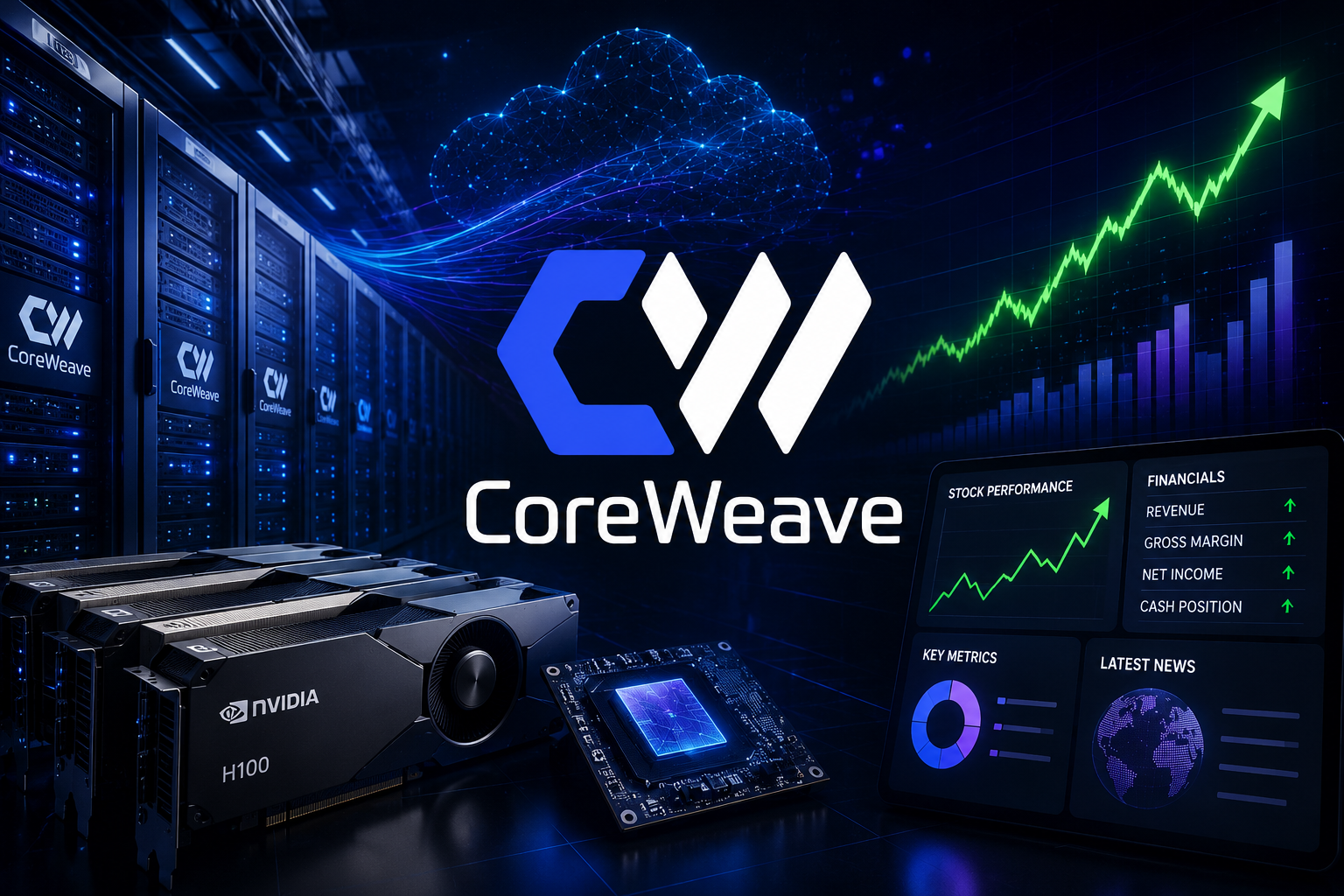
CoreWeave, Inc. (NASDAQ: CRWV) is a specialized cloud computing company that rents out Nvidia graphics processing units and data center capacity to artificial intelligence labs, hyperscalers, and enterprises. Founded in New Jersey in 2017 and originally built around cryptocurrency mining, the company pivoted to GPU cloud infrastructure and went public on the Nasdaq on March 28, 2025 at $40 per share.
CoreWeave posted first quarter 2026 revenue of $2.08 billion, up 112 percent year over year, with a contracted revenue backlog of roughly $99.4 billion.
Major customers include Microsoft, OpenAI, Meta, Anthropic, and Jane Street, with Nvidia also acting as both a supplier and a strategic investor.
The stock trades well below its 2025 highs near $187 after a mid 2026 selloff tied to reports that Meta may enter the AI cloud market as a competitor.
CoreWeave does not pay a dividend and instead reinvests essentially all of its capital into GPUs, data centers, and power infrastructure.
The company joined the Nasdaq 100 Index in June 2026, roughly fifteen months after its IPO.
Quick Facts
CoreWeave, Inc. at a glance (figures current as of early July 2026)
Ticker
CRWV (Nasdaq Global Select Market)
Founded
September 2017, originally as Atlantic Crypto
Renamed CoreWeave
December 2019
Headquarters
Livingston, New Jersey, United States
Founders
Michael Intrator, Brian Venturo, Brannin McBee, Peter Salanki
CEO
Michael Intrator (Chief Executive Officer and President)
IPO date
March 28, 2025, priced at $40.00 per share
Industry
AI cloud infrastructure, GPU compute as a service
Market capitalization
Approximately $44.6 billion
Revenue backlog
Approximately $99.4 billion as of March 31, 2026
Latest quarterly revenue
$2.08 billion (Q1 2026), up 112 percent year over year
Dividend
None paid
Key supplier and investor
Nvidia (NASDAQ: NVDA)
Key customers
Microsoft, OpenAI, Meta, Anthropic, Jane Street
What Is CoreWeave?
CoreWeave is an American cloud infrastructure company that specializes in renting graphics processing unit, or GPU, computing power to organizations that build and run artificial intelligence systems. Rather than offering a broad general purpose cloud like Amazon Web Services or Microsoft Azure, CoreWeave focuses almost entirely on the compute intensive workloads behind large language model training, fine tuning, and inference. Its marketing tagline describes the company as The Essential Cloud for AI.
The business model is built on securing large volumes of the newest Nvidia chips, packaging them with proprietary software for scheduling, networking, and reliability, and then signing multi year, multi billion dollar contracts with AI labs and technology giants that need guaranteed access to that compute. This approach has made CoreWeave one of the most closely watched names in the so called neocloud category, a group of specialized providers built specifically around the AI boom rather than legacy enterprise computing.
CoreWeave has grown rapidly since its 2017 founding, expanding from a handful of data centers into dozens of facilities across the United States and Europe, while layering on software acquisitions such as the AI developer platform Weights and Biases to move beyond raw compute rental toward a fuller AI infrastructure stack.
Company History
CoreWeave’s roots go back to 2017, when three commodities traders, Michael Intrator, Brian Venturo, and Brannin McBee, along with engineer Peter Salanki, founded a company called Atlantic Crypto. The original business used GPUs to mine cryptocurrency such as Ethereum. When the crypto market slumped in 2018, the founders recognized that their idle GPU fleet could be repurposed for other demanding computing tasks, including visual effects rendering, scientific simulation, and eventually machine learning.
The company rebranded as CoreWeave in December 2019 and shifted its focus toward general purpose GPU cloud computing. Over the following years it built out data centers in the United States and, later, the United Kingdom, positioning itself early as a specialist infrastructure provider just as demand for AI training compute began to accelerate.
Key milestones
Selected company history timeline
Period
Event
2017
Founded in New Jersey as Atlantic Crypto, originally a cryptocurrency mining operation.
December 2019
Renamed CoreWeave and repositioned as a GPU cloud computing provider.
2023
Built a large scale Nvidia H100 supercomputer cluster in Plano, Texas, described by Nvidia at the time as one of the fastest AI supercomputers in the world.
November 2024
Closed a $650 million secondary share sale with Cisco joining as an investor ahead of the IPO.
February 2025
Became the first cloud provider to offer Nvidia GB200 NVL72 systems commercially.
March 2025
Announced the acquisition of AI developer platform Weights and Biases for roughly $1.7 billion, signed a five year, roughly $11.9 billion cloud contract with OpenAI, and completed its IPO on March 28, 2025 at $40 per share.
July 2025
Became the first company to commercially deploy Nvidia GB300 NVL72, also known as Blackwell Ultra, in partnership with Dell.
October 2025
Terminated its proposed roughly $9 billion all stock acquisition of data center operator Core Scientific after Core Scientific shareholders voted against the deal.
January 2026
Nvidia made a $2.0 billion private placement investment in CoreWeave at $87.20 per share.
April 2026
Signed a multi year agreement with Anthropic, expanded its Meta partnership to roughly $21 billion, priced an upsized $3.5 billion convertible notes offering, and received a $1 billion investment from Jane Street alongside a $6 billion cloud deal.
May 2026
Reported first quarter 2026 results with revenue of $2.08 billion and a contracted backlog nearing $100 billion.
June 2026
Added to the Nasdaq 100 Index, about fifteen months after its public listing.
Founders
CoreWeave was co-founded by four people whose backgrounds combine commodities trading with hands on infrastructure engineering.
Michael Intrator
Co-founder, Chief Executive Officer, and President. A former commodities and energy trader, Intrator has led CoreWeave’s strategic direction, capital raises, and its transformation from a crypto mining outfit into a major AI infrastructure provider.
Brian Venturo
Co-founder and Chief Strategy Officer, previously the company’s Chief Technology Officer. Venturo has been central to CoreWeave’s technical architecture and its relationship with Nvidia.
Brannin McBee
Co-founder and director, another former commodities trader who helped structure the company’s early trading and infrastructure strategy.
Peter Salanki
Co-founder and engineer, credited with much of the early technical build out of the company’s GPU cloud platform.
The three trader co-founders, Intrator, Venturo, and McBee, held roughly 83 percent of CoreWeave’s voting power heading into the IPO through a dual class share structure, giving them continued control over major corporate decisions even after going public.
CEO
Michael Intrator serves as Chief Executive Officer and President of CoreWeave. He has held the top leadership role since the company’s founding and has been the public face of its rapid transition from a niche crypto and rendering business into one of the most prominent AI infrastructure companies on Wall Street. Intrator has overseen CoreWeave’s IPO, its large scale partnerships with Nvidia, Microsoft, OpenAI, Meta, and Anthropic, and its aggressive capital spending plan aimed at building gigawatts of AI focused data center capacity by the end of the decade.
Headquarters
CoreWeave is headquartered in Livingston, New Jersey. The company also maintains a significant international presence, including an office in London, and operates data centers across the United States and Europe. As of 2025 CoreWeave reported roughly 32 data centers with a combined fleet of about 250,000 GPUs, a sharp increase from just 13 United States facilities and two United Kingdom sites in 2024. The company has continued to expand its geographic footprint through 2026, including new capacity commitments in Pennsylvania and additional investment in the United Kingdom.
Business Segments
CoreWeave operates as a single reportable business focused on AI cloud infrastructure, but its activities can be grouped into several functional segments that together make up its platform.
GPU and CPU compute
Rental of Nvidia GPU clusters and supporting CPU compute for AI training, fine tuning, and inference workloads, billed under long term reserved contracts or shorter term arrangements.
Data, storage, and networking
High throughput storage and data movement tools, including CoreWeave’s Local Object Transport Accelerator, plus networking services designed for large GPU clusters.
Infrastructure control and orchestration
Software such as the CoreWeave Kubernetes Service and Mission Control, which manage node, rack, and fleet lifecycle across large data center deployments.
AI developer tools and MLOps
Model and agent development tools gained through acquisitions such as Weights and Biases, OpenPipe, Monolith AI, and Marimo, extending CoreWeave beyond raw compute into the AI development workflow.
Products and Services
CoreWeave’s core offering is the CoreWeave Cloud Platform, an integrated set of proprietary software and cloud services built specifically for AI infrastructure at scale. Within that platform, the company offers several notable products.
GPU compute: Access to Nvidia’s latest chip generations, including the H100, the GB200 NVL72, and the GB300 NVL72, also known as Blackwell Ultra, which CoreWeave was first to deploy commercially.
CoreWeave Kubernetes Service: A managed Kubernetes offering tailored to orchestrating large GPU clusters for AI workloads.
Local Object Transport Accelerator: A data and storage solution designed to move large training datasets efficiently across a cluster.
Mission Control: Node, rack, and fleet lifecycle management tools aimed at maximizing uptime and utilization across CoreWeave’s data centers.
Weights and Biases: An AI developer platform for experiment tracking, model evaluation, and inference, acquired in 2025 for roughly 1.7 billion dollars.
ARIA: CoreWeave’s AI Research and Iteration Agent, an in house research agent built on top of its own infrastructure.
Managed services: Virtual and bare metal servers, visual effects rendering support, and batch processing for enterprises outside the core AI training use case.
Revenue Breakdown
CoreWeave’s revenue is heavily concentrated among a small number of very large customers that sign multi year, dollar denominated compute contracts. According to company disclosures, Microsoft alone accounted for roughly 67 percent of CoreWeave’s revenue in fiscal year 2025, underscoring how dependent the business has historically been on a single hyperscaler relationship. Management has said it is actively working to diversify that base.
Contracted revenue backlog by major customer relationship
Figures are approximate contracted backlog values in billions of dollars as reported through the first quarter of 2026. *Meta figure reflects an implied cumulative commitment as the relationship has expanded; the originally announced agreement was valued at approximately 21 billion dollars. Total backlog also includes Microsoft, Anthropic, and other customers not shown individually.
Beyond Microsoft, CoreWeave’s largest disclosed relationships include a roughly $11.9 billion, five year cloud computing contract with OpenAI signed in March 2025, an expanding partnership with Meta valued at approximately $21 billion, a multi year agreement to support Anthropic’s Claude models signed in April 2026, and a combined $6 billion cloud deal and $1 billion equity investment from trading firm Jane Street. Nvidia itself contributes to the revenue picture indirectly through a take or pay capacity backstop agreement worth an initial $6.3 billion, under which Nvidia agrees to purchase unused CoreWeave data center capacity through April 2032.
Financial Performance
CoreWeave’s financial profile is defined by extremely fast revenue growth alongside large net losses, heavy capital expenditure, and rising interest costs tied to debt used to fund GPU and data center purchases.
Quarterly revenue growth momentum
Q1 2026 revenue of $2.08 billion topped analyst expectations of about $1.97 billion and more than doubled from the prior year period.
Selected first quarter 2026 financial results
Metric
Q1 2026
Year over year change
Revenue
$2.08 billion
Up 112 percent
Net loss
$740 million
Widened from $315 million
Adjusted EBITDA
Approximately $1.16 billion to $1.2 billion
Margin of about 56 percent
Revenue backlog
$99.4 billion
Up from $66.8 billion at year end 2025
Quarterly interest expense
$536 million
Roughly doubled from the prior quarter
Capital expenditure: 2025 actual versus 2026 guidance
Management raised the low end of its 2026 capital expenditure guidance to $31 billion, citing rising GPU and component costs, roughly double what CoreWeave spent building infrastructure in 2025.
Looking ahead, CoreWeave has guided for full year 2026 revenue of $12 billion to $13 billion, with an exit run rate for the fourth quarter between $18 billion and $19 billion. Management has also pointed to a 2027 revenue run rate above $30 billion, of which the majority is described as already contracted. Roughly 36 percent of the current backlog is expected to convert into recognized revenue within the next two years, with about 75 percent expected to convert within four years.
Why the losses matter: CoreWeave’s net losses are driven largely by depreciation on its rapidly expanding GPU fleet and rising interest expense on the debt used to finance that buildout, not by a lack of demand. Investors watching the stock tend to focus on backlog conversion, interest expense as a share of revenue, and customer concentration rather than near term GAAP profitability.
Stock Information
CoreWeave shares began trading on the Nasdaq Global Select Market on March 28, 2025, after the company priced its initial public offering at $40.00 per share, below its original target range, and reduced the deal size from $2.7 billion to $1.5 billion amid choppy market conditions. Even so, it ranked as one of the largest AI related listings of the year by amount raised.
Key stock price levels since the IPO
CRWV touched an all time high near $187 in June 2025 before pulling back sharply. As of early July 2026 shares traded in the low $80s, down roughly 55 to 60 percent from that peak yet still well above the IPO price.
Snapshot trading data as of early July 2026
Recent share price
Approximately $82
Market capitalization
Approximately $44.6 billion
52 week range
Roughly $63.80 to $166.22, varying slightly by data provider and time window
All time high
$187.00, reached June 20, 2025
All time low
$33.52, reached April 21, 2025
Beta
Approximately 3.03, indicating high volatility relative to the broader market
Price to earnings ratio
Negative, reflecting current net losses
Index membership
Added to the Nasdaq 100 Index effective June 22, 2026
CRWV is known for large price swings tied to individual news events, including earnings reports, new mega contracts, competitor announcements, and shifts in broader sentiment toward AI infrastructure spending. Analyst price targets have varied widely, with some firms setting targets well above $200 and others far more cautious, reflecting genuine disagreement over how quickly CoreWeave can convert its backlog into sustainable profit.
Dividends
CoreWeave does not currently pay a dividend to shareholders. As a fast growing, capital intensive infrastructure company that is still generating net losses on a GAAP basis, CoreWeave has chosen to direct essentially all available cash and financing toward GPUs, data centers, and power capacity rather than shareholder distributions. This is a common approach among early stage, high growth infrastructure companies, and it is consistent with how competitors in the AI cloud space are currently allocating capital. Investors seeking income rather than growth exposure would typically look elsewhere, since CoreWeave’s investment case is centered on capital appreciation tied to AI infrastructure demand rather than yield.
Competitors
CoreWeave competes across several layers of the cloud and AI infrastructure market, from other specialized neoclouds to the largest hyperscalers in the world.
Selected CoreWeave competitors
Competitor
Positioning
Microsoft Azure
Major hyperscaler and also one of CoreWeave’s largest customers, creating a relationship that is both cooperative and competitive.
Amazon Web Services
The largest general purpose cloud provider, increasingly investing in its own custom AI chips and GPU capacity.
Google Cloud
Hyperscaler with its own custom Tensor Processing Units alongside Nvidia GPU offerings.
Oracle Cloud Infrastructure
Aggressively expanding GPU cloud capacity for large AI training contracts.
Nebius Group (NBIS)
A close peer neocloud with a similar Nvidia centric GPU rental model and comparable hyperscaler contracts.
IREN
Originally a Bitcoin mining company that has pivoted toward AI and high performance computing data centers.
Lambda and Crusoe
Privately held specialized GPU cloud providers targeting similar AI training and inference workloads.
Meta Platforms
Historically one of CoreWeave’s customers, Meta has reportedly been exploring a plan called Meta Compute to sell its own excess AI computing capacity, raising the prospect that a major customer could also become a direct competitor.
The competitive picture shifted meaningfully in mid 2026 after reports that Meta was developing plans to commercialize its own AI infrastructure. Because Meta is simultaneously a large CoreWeave customer, any move by Meta to sell spare compute directly to the market would represent both a loss of potential future demand and a new, well capitalized rival.
Recent News
July 2026, Meta cloud competition concerns: Reports that Meta Platforms is developing plans to sell excess AI computing capacity through a business referred to as Meta Compute sent CRWV shares down sharply over several trading sessions, with the stock falling roughly 14 to 15 percent in a short window as investors weighed customer concentration risk against long term demand growth.
June 2026, Nasdaq 100 inclusion: CoreWeave was added to the Nasdaq 100 Index, a milestone reached about fifteen months after its IPO and one that mechanically increases demand for the stock from index tracking funds.
May 2026, first quarter results: CoreWeave reported revenue of $2.08 billion, beating estimates, alongside a record bookings quarter that pushed its contracted backlog to nearly $100 billion.
April 2026, expanded partnerships and financing: The company announced a multi year agreement with Anthropic to support Claude model infrastructure, an expanded roughly $21 billion partnership with Meta, a $1 billion investment and $6 billion cloud agreement with Jane Street, and an upsized $3.5 billion convertible notes offering.
January 2026, Nvidia equity investment: Nvidia invested $2.0 billion in CoreWeave through a private placement priced at $87.20 per share, deepening a relationship that already includes a multi billion dollar capacity backstop agreement.
October 2025, Core Scientific deal terminated: CoreWeave’s proposed roughly $9 billion all stock acquisition of data center operator Core Scientific was called off after Core Scientific shareholders voted against the transaction.
Ongoing, insider stock sales: CoreWeave executives, including CEO Michael Intrator, have periodically sold portions of their holdings under scheduled trading plans, a routine practice among executives at fast growing, richly valued technology companies but one that some investors watch closely for sentiment signals.
Ongoing, securities litigation: CoreWeave has faced multiple shareholder securities lawsuits following its IPO and subsequent stock volatility, a common occurrence for high profile, high volatility technology listings and something prospective investors should research independently before making decisions.
Frequently Asked Questions
What does CoreWeave actually do?
CoreWeave rents out Nvidia GPU computing power and related infrastructure software to companies building and running artificial intelligence models, positioning itself as a specialized alternative to general purpose cloud providers like AWS, Azure, and Google Cloud.
Is CoreWeave profitable?
No. CoreWeave has continued to report GAAP net losses, including a net loss of $740 million in the first quarter of 2026, driven mainly by depreciation on its rapidly growing GPU fleet and rising interest expense on debt used to fund that expansion. The company does report positive adjusted EBITDA.
Who are CoreWeave’s biggest customers?
Microsoft has historically been CoreWeave’s largest customer, accounting for roughly 67 percent of fiscal year 2025 revenue. Other major customers and partners include OpenAI, Meta, Anthropic, and Jane Street.
Does CoreWeave pay a dividend?
No. CoreWeave does not currently pay a dividend and reinvests its capital into GPUs, data centers, and power infrastructure to support its growth strategy.
Why has CRWV stock been so volatile?
CRWV carries a high beta, meaning it tends to move more sharply than the broader market. Its price is highly sensitive to news about individual contracts, hyperscaler capital spending plans, interest rates, and competitive threats, such as 2026 reports about Meta potentially entering the AI cloud market.
When did CoreWeave go public?
CoreWeave completed its initial public offering on March 28, 2025, pricing shares at $40.00 and listing on the Nasdaq under the ticker CRWV.
What is CoreWeave’s relationship with Nvidia?
Nvidia is both CoreWeave’s primary chip supplier and a strategic investor, having made a $2.0 billion equity investment in January 2026. The two companies also have a multi billion dollar capacity backstop agreement under which Nvidia can purchase unused CoreWeave data center capacity through 2032.
What is CoreWeave’s revenue backlog and why does it matter?
The revenue backlog represents contracted future revenue that customers have committed to under long term agreements. CoreWeave’s backlog reached approximately $99.4 billion as of March 31, 2026, which investors use as a signal of future demand even though the company has not yet recognized that revenue.
This article is for general informational and educational purposes only and does not constitute investment, financial, tax, or legal advice. Stock prices, financial figures, and company statistics change frequently and the numbers above reflect publicly reported data available as of early July 2026, which may have since changed. Always verify current figures with primary sources such as CoreWeave’s investor relations page and official SEC filings, and consult a licensed financial advisor before making investment decisions. This article does not constitute a recommendation to buy or sell any security.