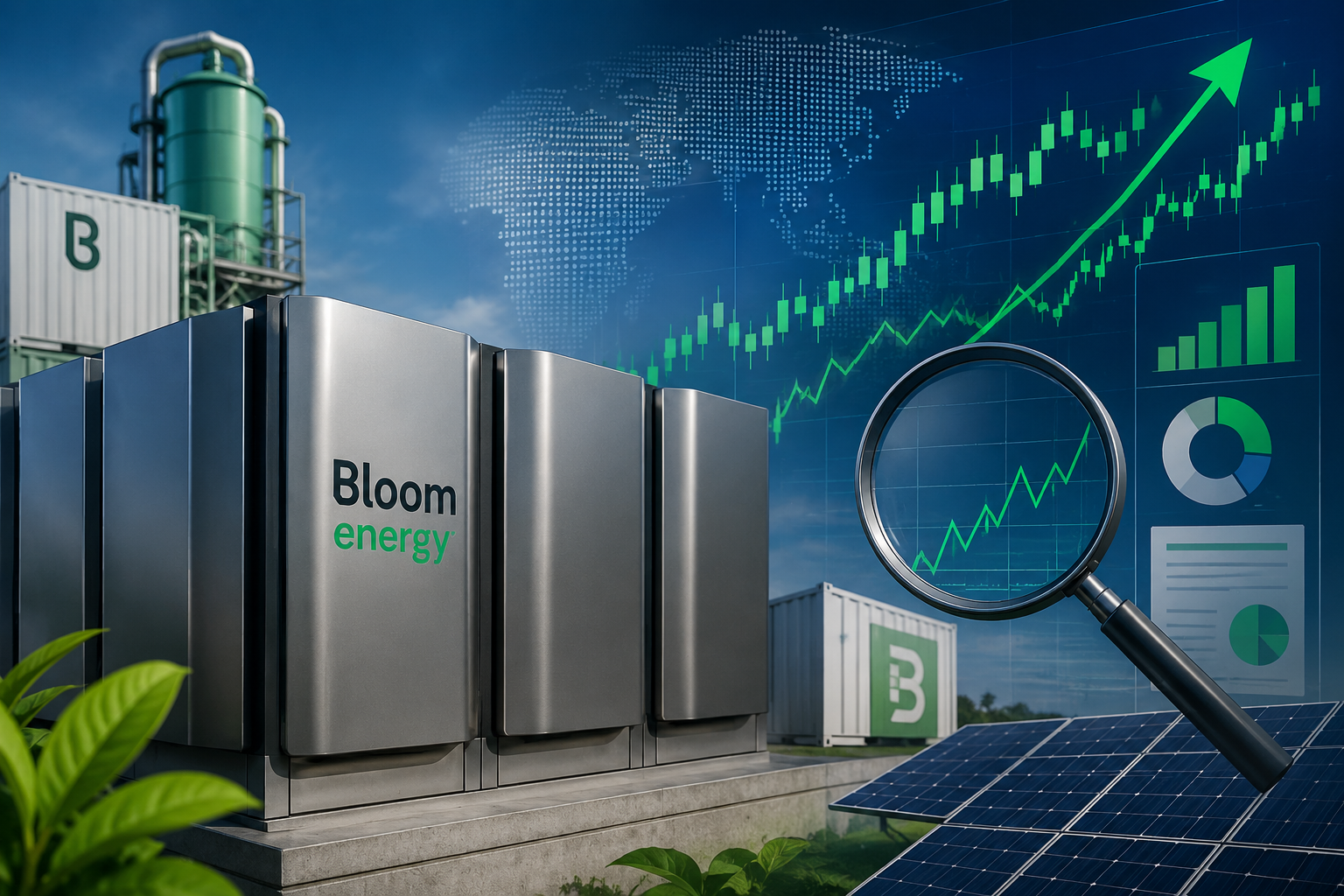
Bloom Energy Corporation (NYSE: BE) designs and manufactures solid oxide fuel cell systems, known as Energy Servers, that generate electricity on site through an electrochemical process rather than combustion. Founded in 2001 by K.R. Sridhar, a former NASA researcher, and headquartered in San Jose, California, the company has become one of the fastest growing names in power infrastructure thanks to surging demand for fast, reliable, behind the meter electricity from AI data centers.
Bloom Energy reported record first quarter 2026 revenue of $751.1 million, up 130.4 percent year over year, and swung to GAAP net income of $70.7 million from a prior year loss.
Management raised full year 2026 revenue guidance to a range of $3.4 billion to $3.8 billion, implying roughly 80 percent growth at the midpoint, driven largely by AI and data center demand.
Major recent deals include an expanded master services agreement with Oracle for up to 2.8 gigawatts of fuel cell capacity, a $2.65 billion offtake agreement with American Electric Power, and a strategic financing partnership with Brookfield that was expanded from $5 billion to $25 billion.
Bloom Energy does not pay a dividend, reinvesting its cash into manufacturing capacity expansion to meet a backlog reported near $20 billion.
BE stock has been one of the strongest performers in the market over the past year, though it remains volatile and trades at a high valuation relative to current GAAP earnings.
Quick Facts
Bloom Energy Corporation at a glance (figures current as of early July 2026)
Ticker
BE (New York Stock Exchange)
Founded
2001, originally as Ion America Corp
Renamed Bloom Energy
2006
Headquarters
San Jose, California, United States
Founder
K.R. Sridhar
CEO
K.R. Sridhar (Founder, Chairman, and Chief Executive Officer)
IPO date
July 2018, listed on the New York Stock Exchange
Industry
Distributed power generation, solid oxide fuel cells, hydrogen electrolyzers
Market capitalization
Roughly $80 billion to $90 billion, varying with daily trading
Q1 2026 revenue
$751.1 million, up 130.4 percent year over year
FY2026 revenue guidance
$3.4 billion to $3.8 billion
Reported backlog
Approximately $20 billion
Dividend
None paid
Key customers and partners
Oracle, Brookfield, American Electric Power, SK ecoplant, Equinix
What Is Bloom Energy?
Bloom Energy is an American clean energy technology company that designs, manufactures, and installs solid oxide fuel cell systems for on site power generation. Its core product, the Bloom Energy Server, converts fuel such as natural gas, biogas, or hydrogen into electricity through a non combustion electrochemical process, similar in concept to a battery that continuously converts fuel into power rather than storing a fixed charge.
The company’s technology is designed to be installed directly at a customer’s site, whether a data center, hospital, factory, or retail location, allowing that customer to generate its own power without waiting years for new grid interconnection capacity. This has made Bloom Energy an increasingly important supplier to the fast growing artificial intelligence data center industry, where operators need large amounts of reliable electricity delivered far faster than traditional utility grid upgrades typically allow.
Bloom Energy’s systems are marketed as clean, quiet, and modular, since they do not rely on combustion or on site water use for cooling in the way traditional gas turbines or diesel generators do, which the company argues helps projects move through local permitting and community approval processes more smoothly.
Company History
Bloom Energy traces its origins to NASA funded research led by K.R. Sridhar, an aerospace engineer who, while directing the Space Technologies Laboratory at the University of Arizona, developed technology intended to convert Martian atmospheric gases into oxygen for a planned Mars mission. When that NASA mission was cancelled, Sridhar and collaborators, including co-founder Jim McElroy, adapted the underlying solid oxide electrochemical technology to run in reverse, combining fuel and oxygen to generate electricity instead.
The company was founded in 2001 as Ion America Corp and operated largely in stealth mode for nearly a decade while refining its technology. It moved to the NASA Ames Research Center in Silicon Valley in 2002 and was renamed Bloom Energy in 2006. The company emerged publicly in February 2010 with a launch event unveiling the Bloom Energy Server, nicknamed the Bloom Box, which attracted significant media attention as an early example of distributed, non combustion power generation.
Key milestones
Selected company history timeline
Period
Event
2001
Founded as Ion America Corp by K.R. Sridhar following the cancellation of a NASA Mars mission he had been working on.
2006
Renamed Bloom Energy Corporation.
July 2008
Shipped its first 100 kilowatt commercial Energy Server units to Google.
February 2010
Publicly unveiled the Bloom Energy Server, or Bloom Box, ending nearly a decade of largely secretive development.
July 2018
Completed its initial public offering on the New York Stock Exchange under the ticker BE.
2020
Pivoted part of its manufacturing capacity to help refurbish ventilators during the early COVID-19 pandemic.
2023 to 2024
Expanded partnerships with South Korea’s SK ecoplant and continued building out its Delaware manufacturing facility to scale domestic production.
2025
Signed an initial $5 billion strategic financing partnership with Brookfield aimed at powering AI data center infrastructure.
January 2026
Finalized a $2.65 billion, 20 year offtake agreement with American Electric Power for up to 1 gigawatt of fuel cell capacity.
April 2026
Announced an expanded master services agreement with Oracle covering up to 2.8 gigawatts of Bloom’s fuel cell systems to support Oracle’s AI and cloud infrastructure buildout, including its Project Jupiter data center program.
Mid 2026
Expanded its Brookfield strategic partnership from $5 billion to $25 billion in available project financing for AI focused power deployments.
Founders
Bloom Energy was principally founded by K.R. Sridhar, drawing on his background in aerospace engineering and prior NASA supported research.
K.R. Sridhar
Founder, Chairman, and Chief Executive Officer. An Indian American engineer with a PhD in mechanical engineering, Sridhar previously directed the Space Technologies Laboratory at the University of Arizona and advised NASA on technology to produce oxygen from Martian atmospheric gases before founding Bloom Energy in 2001.
Jim McElroy
Co-founder, who brought earlier experience developing hydrogen fuel cell technology used during NASA’s Gemini program, contributing foundational expertise to Bloom’s solid oxide fuel cell design.
The company operated for nearly a decade before publicly revealing its technology, during which it raised substantial venture capital from firms including Kleiner Perkins and New Enterprise Associates to fund development of its solid oxide fuel cell stacks.
CEO
K.R. Sridhar has served as Bloom Energy’s Founder, Chairman, and Chief Executive Officer since the company’s founding in 2001. Before Bloom, Sridhar was a professor of Aerospace and Mechanical Engineering and Director of the Space Technologies Laboratory at the University of Arizona, where he worked on NASA funded research related to Mars exploration. He holds a bachelor’s degree in mechanical engineering from the National Institute of Technology in Tiruchirappalli, India, along with a master’s degree in nuclear engineering and a PhD in mechanical engineering from the University of Illinois at Urbana-Champaign. Sridhar has led Bloom Energy through its multi decade transition from a stealth mode research project into a major public power infrastructure supplier, and has become a prominent voice on the growing electricity demands of artificial intelligence data centers.
Headquarters
Bloom Energy is headquartered in San Jose, California, at 4353 North First Street, having moved its headquarters there from Sunnyvale, California in 2018 around the time of its initial public offering. The company also operates a major manufacturing facility in Delaware, established to expand domestic production capacity for its Energy Server systems, along with additional operations supporting its growing international footprint, including projects in South Korea, Japan, and other markets.
Business Segments
Bloom Energy reports its results largely as a single power generation technology business, but its commercial activity spans several functional areas.
Product sales
Direct sale of Bloom Energy Server systems to customers such as data center operators, utilities, and industrial facilities, historically the largest and fastest growing part of total revenue.
Installation services
Site preparation, installation, and commissioning services delivered alongside product sales to get Energy Server systems operational at a customer location.
Service and maintenance
Long term service contracts that maintain and monitor deployed Energy Servers, creating a recurring, annuity like revenue stream tied to the installed base.
Electricity sales
In some arrangements, Bloom or its financing partners retain ownership of an Energy Server installation and sell the electricity it generates directly to the end customer under a long term power agreement.
Products and Services
Bloom Energy’s product lineup centers on its core solid oxide fuel cell platform, supplemented by newer hydrogen related offerings.
Bloom Energy Server: The company’s flagship product, a modular fuel cell platform that converts natural gas, biogas, hydrogen, or blends of these fuels into electricity without combustion, suitable for continuous, always on power generation.
Bloom Electrolyzer: A solid oxide electrolyzer system that runs the fuel cell process in reverse, using electricity to produce hydrogen, positioning Bloom to participate in the broader hydrogen production and storage market.
Microgrid solutions: Combined Energy Server deployments designed to provide resilient, always on power independent of grid outages, used in facilities ranging from manufacturing plants to hospitals.
AI data center power blocks: Large scale, multi unit Energy Server deployments purpose built to replace or supplement traditional gas turbines and diesel backup generators at AI and cloud computing data centers, as demonstrated in Bloom’s agreement with Oracle.
Service and monitoring contracts: Ongoing maintenance and performance monitoring for deployed systems, supporting what the company describes as close to a 100 percent attach rate between product sales and long term service agreements.
Revenue Breakdown
Bloom Energy’s revenue is split across product sales, installation, service, and electricity, with product sales making up the large majority of the total and driving most of the company’s recent growth.
Q1 2026 revenue by category
Product sales made up the vast majority of Bloom Energy’s $751.1 million in first quarter 2026 revenue, up 208.4 percent year over year, reflecting the scale of new AI data center and utility deployments.
Beyond the reported revenue categories, Bloom Energy’s forward revenue picture is shaped heavily by a small number of very large contracts. The company’s expanded master services agreement with Oracle covers up to 2.8 gigawatts of fuel cell capacity to support AI and cloud infrastructure, while its offtake agreement with American Electric Power is valued at approximately $2.65 billion over 20 years for up to 1 gigawatt of capacity. Management has described more than half of its current data center backlog as coming from hyperscalers, neoclouds, and colocation providers beyond the Oracle relationship, indicating a broadening customer base rather than dependence on a single buyer.
Financial Performance
Bloom Energy’s financial profile has shifted sharply over the past year, moving from a company with persistent GAAP losses to one posting record revenue growth alongside its first quarterly GAAP profit in some time.
Quarterly revenue growth
Bloom Energy’s first quarter 2026 revenue of $751.1 million more than doubled from the prior year period, the company’s first quarter with revenue growth exceeding 100 percent year over year since going public.
Selected first quarter 2026 financial results
Metric
Q1 2026
Year over year change
Revenue
$751.1 million
Up 130.4 percent
GAAP gross margin
30.0 percent
Up from 27.2 percent
Non-GAAP gross margin
31.5 percent
Up 2.8 percentage points
GAAP net income
$70.7 million
Reversed a prior year net loss
Non-GAAP operating income
$129.7 million
17.3 percent operating margin
Adjusted EBITDA
$143.0 million
Approximately 19 percent margin
Operating cash flow
$73.6 million
Improved by $184.3 million
Cash and cash equivalents
Approximately $2.49 billion
Against recourse debt of about $2.60 billion
Full year 2026 revenue guidance versus 2025
Management raised full year 2026 revenue guidance to $3.4 billion to $3.8 billion, implying roughly 80 percent year over year growth at the midpoint, alongside non-GAAP gross margin guidance of approximately 34 percent.
For full year 2026, Bloom Energy has guided for non-GAAP operating income of $600 million to $750 million, non-GAAP earnings per share of $1.85 to $2.25, and adjusted EBITDA of $650 million to $800 million, alongside expectations for operating cash flow above $200 million. Management has framed this growth around a shift toward continuous, non lumpy capacity additions, targeting hundreds of megawatts of new manufacturing capacity per quarter as it scales toward a roughly 5 gigawatt annual production footprint.
Why the margin story matters: Bloom Energy’s history includes years of GAAP losses and, at times, criticism over accounting practices and cost overruns in its early public years. The shift toward consistent gross margin expansion, positive operating cash flow, and GAAP profitability in recent quarters is viewed by many analysts as a meaningfully different phase for the business, driven by manufacturing scale and a large base of long duration AI data center contracts.
Stock Information
Bloom Energy completed its initial public offering on the New York Stock Exchange in July 2018. The stock endured a volatile first several years as a public company, including a decline of nearly 50 percent by 2020 amid questions about the company’s path to profitability, before surging dramatically starting in 2025 as demand for AI data center power reshaped investor perception of the business.
Key stock price levels over the past year
Bloom Energy shares have traded across an extremely wide 52 week range, from a low near $21.52 to an all time high of $351.28, reflecting both explosive investor enthusiasm around AI power demand and sharp bouts of volatility.
Snapshot trading data as of early July 2026
Recent share price
Roughly $280 to $300, varying by session
Market capitalization
Approximately $80 billion to $90 billion depending on the trading day
52 week range
Approximately $21.52 to $351.28
One year return
Over 1,000 percent, among the strongest of any large cap stock over the period
Price to earnings ratio
Extremely high or not meaningful on a trailing GAAP basis, reflecting the company’s recent shift to profitability
Average analyst rating
Generally Buy, with price targets raised by multiple firms into the $275 to $350 range following recent earnings and partnership news
BE shares have moved sharply on individual pieces of news throughout 2026, including double digit single day swings tied to major contract announcements such as the Oracle master services agreement, the expanded Brookfield financing partnership, and shifting sentiment toward competing fuel cell names such as FuelCell Energy and Plug Power. This level of volatility is typical for a stock whose valuation reflects expectations of continued rapid growth rather than current trailing earnings.
Dividends
Bloom Energy does not pay a dividend. The company is directing its cash flow and balance sheet capacity toward funding rapid manufacturing expansion, research and development, and project financing needed to fulfill its large data center and utility contract backlog. This approach is standard for a capital intensive growth technology company in the early stages of scaling profitability, and investors in BE are generally positioned for capital appreciation tied to continued growth in AI and data center power demand rather than income.
Competitors
Bloom Energy competes primarily within the stationary fuel cell and distributed power generation market, alongside a broader set of companies addressing the AI data center power shortage.
Selected Bloom Energy competitors
Competitor
Positioning
FuelCell Energy (FCEL)
A smaller stationary fuel cell maker that has pursued data center power contracts and integrated thermal to cooling technology to manage AI chip heat, though at a much smaller revenue scale than Bloom.
Plug Power (PLUG)
Focused primarily on green hydrogen production and hydrogen fuel cell systems, marketed as a carbon neutral alternative in regions where natural gas permitting is more difficult.
Generac and Caterpillar
Established manufacturers of traditional gas turbines and diesel backup generators, representing the incumbent, combustion based alternative that Bloom’s non combustion systems are positioned against.
Traditional utilities and grid operators
Data center operators can also choose to wait for expanded grid interconnection capacity from local utilities rather than deploying on site generation, though multi year interconnection queues have driven interest toward faster on site alternatives like Bloom’s.
Capstone Green Energy
A smaller maker of microturbine based distributed generation systems serving some of the same commercial and industrial customer base.
Bloom Energy’s most direct comparisons are typically drawn against FuelCell Energy and Plug Power, since all three are publicly traded fuel cell companies, though Bloom is substantially larger, with first quarter 2026 revenue of $751.1 million compared with roughly $36 million for FuelCell Energy and approximately $164 million for Plug Power over comparable periods. Bloom has also secured deals with data center customers including Oracle, Amazon, and American Electric Power, which analysts frequently cite as evidence of a wider commercial lead over its smaller fuel cell peers.
Recent News
Early July 2026, expanded Brookfield partnership: Bloom Energy and Brookfield announced an expansion of their strategic AI power financing partnership from $5 billion to $25 billion, with shares reacting sharply, including a notable pullback shortly after the announcement as some investors weighed near term dilution and execution questions against the long term financing benefit.
Early July 2026, analyst price target increases: Multiple Wall Street firms raised price targets on Bloom Energy following the Brookfield expansion and continued AI data center momentum, including a target increase to $285 at Roth Capital and constructive commentary from Morgan Stanley on the signal sent by the expanded financing agreement.
April 2026, expanded Oracle agreement: Bloom Energy announced an expanded master services agreement with Oracle under which Oracle intends to procure up to 2.8 gigawatts of Bloom’s fuel cell systems to support its AI and cloud computing infrastructure buildout, including its Project Jupiter data center program, sending shares up sharply on the announcement.
April 2026, record first quarter results: The company reported first quarter 2026 revenue of $751.1 million, up 130.4 percent year over year, alongside a swing to GAAP net income and a material increase to full year 2026 guidance.
January 2026, American Electric Power agreement: Bloom Energy finalized a $2.65 billion, 20 year offtake agreement with American Electric Power for up to 1 gigawatt of solid oxide fuel cell capacity, one of the largest utility scale agreements in the company’s history.
2026, sector wide fuel cell competition: Rivals FuelCell Energy and Plug Power have both drawn renewed investor attention with their own data center related announcements and revenue growth, occasionally pressuring Bloom Energy shares on a relative valuation basis even as Bloom continues to report much larger absolute revenue and contract wins.
2026, continued manufacturing expansion: Bloom Energy has continued to scale production at its California and Delaware manufacturing facilities, working toward a stated goal of adding hundreds of megawatts of new capacity per quarter to support its growing order backlog.
Frequently Asked Questions
What does Bloom Energy actually do?
Bloom Energy designs and manufactures solid oxide fuel cell systems, called Energy Servers, that generate electricity on site through a non combustion electrochemical process using natural gas, biogas, or hydrogen, primarily for data centers, utilities, and commercial and industrial customers.
Is Bloom Energy profitable?
Bloom Energy reported GAAP net income of $70.7 million in the first quarter of 2026, reversing a prior year loss, supported by record revenue growth and expanding gross margins. The company has a history of prior period losses, so continued profitability will depend on sustaining current growth and margin trends.
Who are Bloom Energy’s biggest customers?
Major customers and partners include Oracle, which has agreed to procure up to 2.8 gigawatts of Bloom’s fuel cell systems, American Electric Power, which signed a $2.65 billion utility offtake agreement, and Brookfield, which provides project financing for AI data center deployments under an expanded $25 billion partnership.
Does Bloom Energy pay a dividend?
No. Bloom Energy does not currently pay a dividend and is reinvesting its cash flow into manufacturing capacity expansion to meet a reported order backlog near $20 billion.
Why has BE stock risen so sharply?
BE stock has surged largely due to growing recognition that Bloom’s fuel cell technology can deliver reliable, on site electricity to AI data centers far faster than waiting for traditional utility grid upgrades, combined with a string of large contract wins and improving profitability.
When did Bloom Energy go public?
Bloom Energy completed its initial public offering on the New York Stock Exchange in July 2018 under the ticker BE.
Who founded Bloom Energy and who is the CEO?
Bloom Energy was founded in 2001 by K.R. Sridhar, a former NASA supported aerospace engineer, who continues to serve as the company’s Founder, Chairman, and Chief Executive Officer.
How does Bloom Energy compare to Plug Power and FuelCell Energy?
Bloom Energy is substantially larger than both peers by revenue, reporting $751.1 million in first quarter 2026 revenue compared with roughly $164 million for Plug Power and about $36 million for FuelCell Energy over comparable periods, and Bloom has secured larger scale data center and utility contracts to date.
This article is for general informational and educational purposes only and does not constitute investment, financial, tax, or legal advice. Stock prices, financial figures, and company statistics change frequently and the numbers above reflect publicly reported data available as of early July 2026, which may have since changed. Always verify current figures with primary sources such as Bloom Energy’s investor relations page and official SEC filings, and consult a licensed financial advisor before making investment decisions. This article does not constitute a recommendation to buy or sell any security.