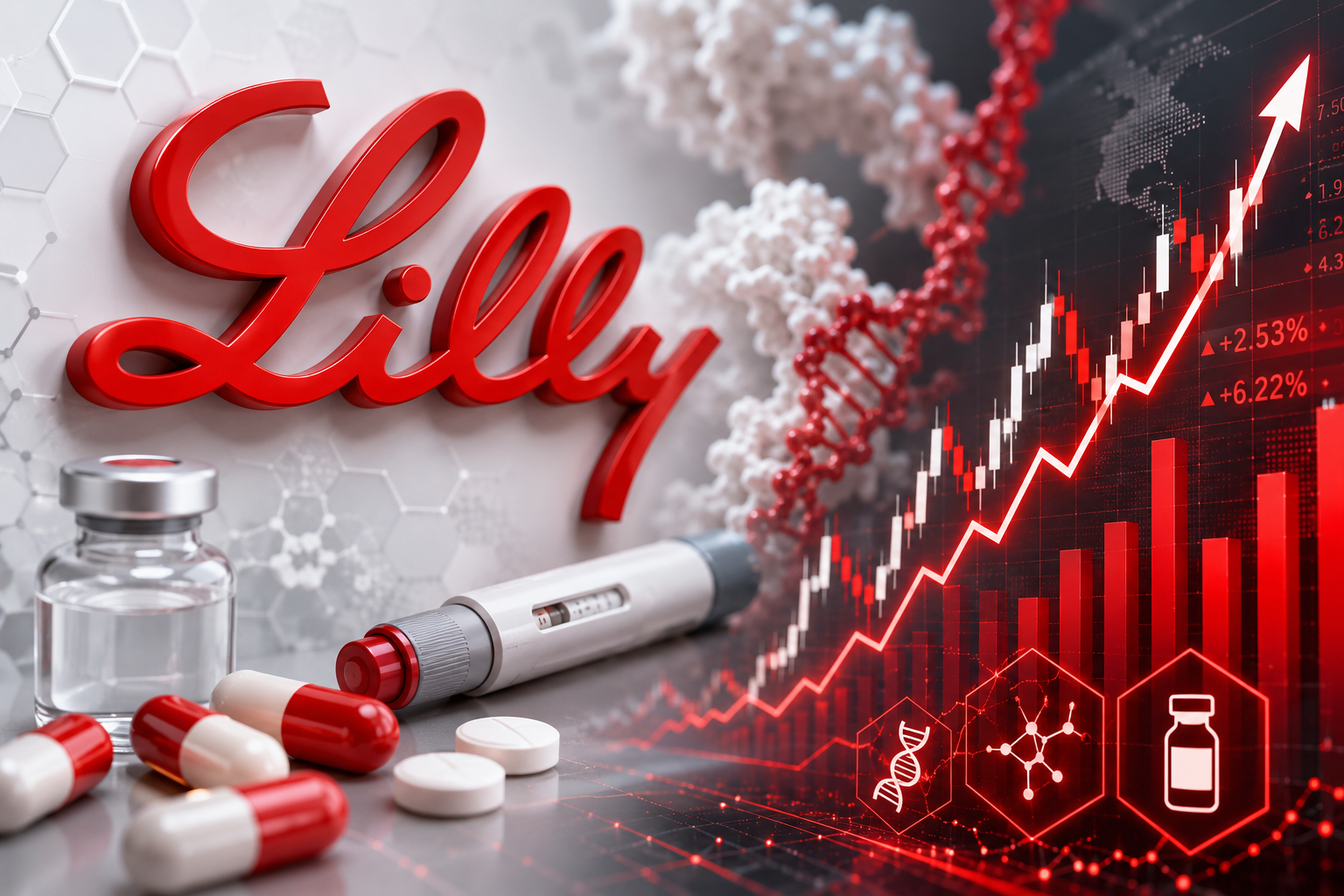
Quick Summary: Eli Lilly and Company (NYSE: LLY) is an Indianapolis, Indiana based pharmaceutical company and the largest drugmaker in the world by market value. Founded in 1876 by Colonel Eli Lilly, the company is best known today for its GLP-1 based diabetes and obesity medicines, Mounjaro and Zepbound, along with treatments across oncology, immunology, neuroscience, and Alzheimer’s disease.
Lilly generated $65.2 billion in revenue for full year 2025, up 45 percent from $45 billion in 2024, driven almost entirely by demand for tirzepatide, the active ingredient in both Mounjaro and Zepbound. Momentum carried into 2026, with first quarter revenue of $19.80 billion, up 55.5 percent year over year. As of early July 2026, LLY trades around $1,225 per share, giving the company a market capitalization of roughly $1.16 trillion, making it the most valuable pharmaceutical company on earth. Lilly pays a growing quarterly dividend, currently $1.73 per share, and has raised its payout for 12 consecutive years.
Legal NameEli Lilly and Company
Ticker SymbolLLY (NYSE)
FoundedMay 10, 1876
HeadquartersIndianapolis, Indiana, USA
Chair, President and CEODavid A. Ricks
IndustryPharmaceuticals and biotechnology
2025 Revenue$65.2 billion
Q1 2026 Revenue$19.80 billion
Approx. Market Cap$1.16 trillion (July 2026)
Quarterly Dividend$1.73 per share
Dividend Streak12 consecutive years of increases
Countries ServedApproximately 90
What Is Eli Lilly and Company?
Eli Lilly and Company is one of the world’s largest pharmaceutical companies, discovering, developing, manufacturing, and marketing prescription medicines that treat diabetes, obesity, cancer, immunological conditions, and neurological disease. The company operates in a single reportable business segment, human pharmaceutical products, and sells its medicines in roughly 90 countries through subsidiaries and distribution partners.
Lilly rose to unprecedented scale in the 2020s on the strength of its incretin franchise, medicines built around a molecule called tirzepatide that mimics gut hormones involved in blood sugar control and appetite regulation. Sold under the brand names Mounjaro for type 2 diabetes and Zepbound for chronic weight management, these drugs turned Lilly into the first company in the biopharmaceutical industry to reach a $1 trillion market capitalization, a milestone it crossed in late 2025.
Beyond diabetes and obesity, Lilly maintains a broad portfolio spanning oncology, immunology, neuroscience, and one of the industry’s most closely watched Alzheimer’s disease treatments, positioning the company as a diversified science driven healthcare business rather than a single product story.
Company History
Eli Lilly and Company traces its roots to May 10, 1876, when Colonel Eli Lilly, a Union Army veteran and pharmaceutical chemist, opened a small drug manufacturing operation in Indianapolis, Indiana, committed to producing medicines of consistent, reliable quality at a time when many remedies on the market were of dubious value. The company grew through the early 20th century into a major pharmaceutical manufacturer, playing a key role in the mass production of insulin after partnering with the University of Toronto researchers who discovered it in the early 1920s, making Lilly synonymous with diabetes care for the following century.
Through the mid and late 20th century, Lilly expanded into antibiotics and psychiatric medicine, most notably the introduction of Prozac in 1987, and agricultural products through its former Elanco animal health division, which the company later spun off as an independent public company in 2019.
The 2010s and early 2020s brought a wave of new product launches across oncology and immunology, but the company’s defining modern chapter began with the 2022 approval of Mounjaro for type 2 diabetes, followed by Zepbound’s approval for chronic weight management in 2023. Demand for these incretin therapies proved so strong that Lilly repeatedly expanded manufacturing capacity, investing tens of billions of dollars in new production facilities across the United States to keep pace with prescriptions. By 2025, annual revenue had surged past $65 billion, more than double the company’s revenue just three years earlier, and Lilly’s market value surpassed that of every other pharmaceutical company in history.
Founders
The company was founded by a single individual:
Colonel Eli Lilly (1838 to 1898), a trained pharmaceutical chemist and American Civil War veteran who established Eli Lilly and Company in Indianapolis in 1876. Lilly built the business around a then novel idea, that medicines should be manufactured to strict, standardized quality controls, gelatin coated capsules among his early innovations.
Leadership of the company remained within the Lilly family for three generations, passing to his son Josiah K. Lilly Sr. and later grandsons Eli Lilly Jr. and Josiah K. Lilly Jr., before transitioning to professional, non family executive management in the latter half of the 20th century. The Lilly Endowment, one of the largest private philanthropic foundations in the United States, was established by family members and remains a major shareholder of the company today.
CEO
David A. Ricks has served as Chair, President, and Chief Executive Officer of Eli Lilly since January 2017. Ricks joined Lilly in 1996 as a business development associate and rose through roles across the company’s international operations, including leadership positions in Lilly’s diabetes business and its operations in China, before being named CEO.
Under Ricks, Lilly’s annual revenue has grown from roughly $22.9 billion in 2017 to $65.2 billion in 2025, an increase of more than 180 percent, while the company’s market capitalization rose from about $82 billion to over $1 trillion, a gain the company has publicly cited as evidence of Ricks’ strategic execution, particularly the early, heavy investment in incretin based diabetes and obesity treatments years before that category became the center of the pharmaceutical industry. Ricks was named Chief Executive magazine’s 2025 CEO of the Year, and his total compensation package for 2025 was reported at $36.7 million, reflecting the company’s strong recent financial performance.
Headquarters
Eli Lilly and Company is headquartered at the Lilly Corporate Center in Indianapolis, Indiana, where the company has been based since its founding in 1876. Indianapolis remains central to Lilly’s identity, and the company is one of the city’s largest employers and a major driver of the state of Indiana’s economy. Lilly also operates significant research, manufacturing, and administrative sites across the United States, including large scale manufacturing investments in Indiana, North Carolina, and other states tied to expanding incretin drug production, along with research and commercial operations across Europe and Asia.
Business Segments
Lilly reports its financial results under a single operating segment, human pharmaceutical products, but internally organizes its portfolio and pipeline around several therapeutic areas:
Cardiometabolic Health: Diabetes and obesity treatments, including the tirzepatide franchise (Mounjaro and Zepbound), insulins such as Humalog and Basaglar, and the SGLT2 inhibitor Jardiance, co developed with Boehringer Ingelheim.
Oncology: Cancer treatments including Verzenios for breast cancer, Jaypirca for certain blood cancers, and Retevmo for specific genetically driven tumors.
Immunology: Treatments for inflammatory and autoimmune conditions, including Taltz for psoriasis and psoriatic arthritis, Omvoh for ulcerative colitis, and Ebglyss for atopic dermatitis.
Neuroscience: Medicines including Emgality for migraine prevention and Kisunla, a treatment for early symptomatic Alzheimer’s disease.
Other and legacy products: A range of older established medicines that continue to generate meaningful revenue even as growth has shifted toward newer categories.
Products and Services
Lilly’s product portfolio spans several therapeutic categories, with a small number of newer medicines now accounting for the majority of the company’s growth.
Product
Category
Primary Use
Mounjaro
Cardiometabolic Health
Type 2 diabetes, weight management
Zepbound
Cardiometabolic Health
Chronic weight management, obesity, sleep apnea
Trulicity
Cardiometabolic Health
Type 2 diabetes, an earlier GLP-1 medicine
Jardiance
Cardiometabolic Health
Type 2 diabetes, heart failure, chronic kidney disease
Lilly’s pipeline includes orforglipron, an experimental oral incretin medicine for diabetes and obesity that, unlike Mounjaro and Zepbound, does not require injection, a development the company has highlighted as a potential future growth driver as it reports results from a series of late stage studies. Lilly has also continued to expand manufacturing capacity through new plant construction across the United States to relieve the supply constraints that limited tirzepatide availability in earlier years of its launch.
Revenue Breakdown
The chart below shows Lilly’s total revenue growth over the past five fiscal years, illustrating how sharply growth has accelerated since the 2022 launch of Mounjaro.
Eli Lilly total revenue by fiscal year. Source: company financial filings.
Full year 2025 revenue reached $65.2 billion, up 45 percent from $45 billion in 2024. Combined sales of Mounjaro and Zepbound totaled $36.5 billion in 2025, up from $16.5 billion in 2024, meaning tirzepatide alone accounted for nearly all of the company’s year over year revenue increase. Momentum continued into 2026, with first quarter revenue of $19.80 billion, up 55.5 percent from the same period a year earlier, again propelled largely by GLP-1 sales alongside contributions from newer medicines such as Ebglyss, Omvoh, and Kisunla.
Geographically, the United States remains Lilly’s largest market by a wide margin, though international sales, particularly across Europe and expanding markets in Asia, are growing as Mounjaro and Zepbound launch in additional countries. By therapeutic category, cardiometabolic health, driven by the incretin franchise, has become by far the largest and fastest growing segment, followed by oncology and immunology, with neuroscience representing a smaller but strategically important category anchored by Kisunla’s Alzheimer’s disease indication.
Financial Performance
The table below summarizes recent annual and quarterly financial results.
Period
Total Revenue
YoY Growth
Non-GAAP EPS
Full Year 2023
$34.1 billion
20%
$9.09
Full Year 2024
$45.0 billion
32%
$12.99
Full Year 2025
$65.2 billion
45%
Approximately $22
Q1 2026 (quarter)
$19.80 billion
55.5%
$8.55
Approximate trend in Eli Lilly quarterly revenue across recent quarters. Source: company financial filings.
Lilly’s profitability has expanded alongside revenue, though heavy investment in manufacturing capacity and research and development has kept growth in earnings somewhat more moderate than the pace of top line sales growth. Non GAAP earnings per share rose from $9.09 in 2023 to $12.99 in 2024, a 106 percent increase, reflecting significant operating leverage as incretin sales scaled. First quarter 2026 non GAAP earnings per share reached $8.55, well above analyst estimates of $6.97, a surprise of more than 22 percent.
The company has funded aggressive capital spending, including multiple new manufacturing facilities across the United States, largely from operating cash flow, while also pursuing business development activity such as the acquisitions of Verve Therapeutics and SiteOne Therapeutics to expand its pipeline in cardiovascular and pain related therapeutic areas.
Stock Information
Metric
Approximate Value
Exchange
New York Stock Exchange
Ticker
LLY
Recent share price
Around $1,225
Approximate market capitalization
$1.16 trillion
52 week range
Roughly $624 to $1,237
Trailing P/E ratio
Approximately 44
Beta
Approximately 0.1 to 0.3, historically defensive relative to the broader market
Next earnings report
Expected around August 5, 2026
LLY has been one of the strongest large cap performers of the past several years, becoming the first pharmaceutical company in history to reach a $1 trillion market capitalization in November 2025 and continuing to climb through the first half of 2026, up roughly 14 percent year to date as of early July 2026. The stock’s 52 week range spans from about $625 to just above $1,236, reflecting a period in 2025 when concerns about GLP-1 competition and pricing policy weighed on shares before renewed confidence in the company’s growth trajectory pushed the stock to new highs.
Analyst sentiment on LLY remains largely positive, with several firms maintaining buy ratings and price targets above current levels heading into the company’s next earnings report, citing continued strength in the incretin franchise, an expanding pipeline including the oral candidate orforglipron, and new Medicare coverage for obesity medicines that could widen the addressable patient population. Risks cited by more cautious analysts include intensifying competition from Novo Nordisk and other entrants into the obesity drug market, potential U.S. drug pricing policy changes, and periodic headline risk tied to international trials and regulatory matters.
Dividends
Eli Lilly has paid a dividend since 1972 and has increased its payout for 12 consecutive years, making it a long standing dividend growth stock even though its current yield is modest relative to the broader pharmaceutical sector. The company currently pays a quarterly dividend of $1.73 per share, equal to $6.92 on an annualized basis, following a roughly 15 percent increase announced in late 2025. At recent share prices, this equates to a dividend yield in the range of 0.53 percent to 0.72 percent, low by traditional income investing standards but consistent with Lilly’s identity as a high growth company that has historically prioritized reinvestment in research, development, and manufacturing capacity over a high current payout.
Lilly’s payout ratio, generally cited in the range of 22 percent to 26 percent of earnings, indicates ample room for continued dividend growth even as the company invests heavily in expanding production of its incretin medicines. Annual dividends per share rose from $4.52 in 2023 to $5.20 in 2024 and $6.00 in 2025, a pace of increase that has outstripped many other large cap dividend payers in recent years.
Competitors
Eli Lilly competes across several distinct pharmaceutical categories, meaning its competitive set varies depending on the therapeutic area in question.
Competitor
Ticker
Primary Overlap
Novo Nordisk
NVO
GLP-1 diabetes and obesity medicines, Lilly’s closest direct rival
Biologics, immunology, and emerging obesity treatments
Roche
RHHBY
Oncology and diagnostics
Novo Nordisk stands out as Lilly’s most direct competitor, since the two companies effectively dominate the fast growing GLP-1 based diabetes and obesity drug category with their respective tirzepatide and semaglutide product lines, sold under brands including Mounjaro, Zepbound, Ozempic, and Wegovy. This head to head rivalry has intensified as new entrants, expanded Medicare and insurance coverage, and a wave of experimental oral incretin candidates from multiple companies threaten to reshape the competitive landscape over the coming years.
Recent News
Medicare begins covering obesity drugs (July 2026): A temporary federal program started allowing eligible Medicare beneficiaries to access GLP-1 medicines for obesity with a copay as low as $50 per month, a policy shift that could significantly expand the addressable patient population for Zepbound.
Strong Q1 2026 results: Lilly reported first quarter revenue of $19.80 billion, up 55.5 percent year over year, driven by continued strength in Mounjaro and Zepbound sales, and the company raised its full year 2026 revenue guidance.
Innovent Biologics distribution deal: Lilly and Innovent Biologics entered into a distribution and promotion agreement covering a CDK4 and 6 inhibitor cancer therapy and the Verzenios franchise in relevant markets.
China trial scrutiny: Lilly faced questions from a U.S. House committee regarding aspects of its clinical trial activities in China, a development that has weighed on investor sentiment at times, though the company has stated it operates its research programs in compliance with applicable regulations.
Continued manufacturing expansion: The company has announced multiple new United States manufacturing facilities in recent quarters to expand tirzepatide and other production capacity, part of a broader multi year, multi billion dollar capital investment program.
Oral incretin pipeline progress: Lilly continues to report results from a series of late stage studies of orforglipron, its experimental oral GLP-1 medicine for diabetes and obesity, viewed by analysts as an important next growth catalyst given the convenience advantage of a pill over an injectable.
Frequently Asked Questions
What does Eli Lilly and Company do?
Eli Lilly discovers, develops, manufactures, and markets prescription pharmaceutical products, with major treatments across diabetes, obesity, oncology, immunology, and neuroscience, including the widely used Mounjaro and Zepbound medicines.
Who founded Eli Lilly and Company and when?
Colonel Eli Lilly, a pharmaceutical chemist and Civil War veteran, founded the company in Indianapolis, Indiana on May 10, 1876.
Who is the CEO of Eli Lilly?
David A. Ricks has served as Chair, President, and Chief Executive Officer since January 2017.
Where is Eli Lilly headquartered?
Eli Lilly is headquartered in Indianapolis, Indiana.
Why has Eli Lilly’s stock grown so much recently?
Growth has been driven primarily by strong demand for the company’s GLP-1 based diabetes and obesity medicines, Mounjaro and Zepbound, which together generated $36.5 billion in sales in 2025 and now account for the majority of the company’s revenue growth.
Does Eli Lilly pay a dividend?
Yes. Lilly pays a quarterly dividend, currently $1.73 per share, and has raised its dividend for 12 consecutive years, though the yield remains relatively low given the stock’s strong price appreciation.
Who is Eli Lilly’s biggest competitor?
Novo Nordisk is generally considered Lilly’s closest competitor, since both companies lead the market for GLP-1 based diabetes and obesity treatments. Other major competitors include Pfizer, Merck, Johnson and Johnson, AbbVie, and Amgen across various therapeutic categories.
What is tirzepatide?
Tirzepatide is the active ingredient shared by Mounjaro, approved for type 2 diabetes, and Zepbound, approved for chronic weight management. It works by mimicking two gut hormones, GLP-1 and GIP, that regulate blood sugar and appetite.
Is Eli Lilly stock a good investment?
This is a personal financial decision that depends on individual goals, risk tolerance, and time horizon. Lilly has delivered exceptional revenue growth and holds a leading position in a fast growing drug category, but the stock trades at a high valuation multiple and faces risks including competition, drug pricing policy, and patent related considerations over the long term. Readers should consult a licensed financial advisor before making investment decisions, since this article is educational and not personalized investment advice.
Sources include Eli Lilly and Company SEC filings and press releases, company earnings call transcripts and investor communications, and public market data providers including Yahoo Finance, CNBC, TradingView, and Koyfin, current as of early July 2026. Figures are subject to change following future earnings reports and market activity.