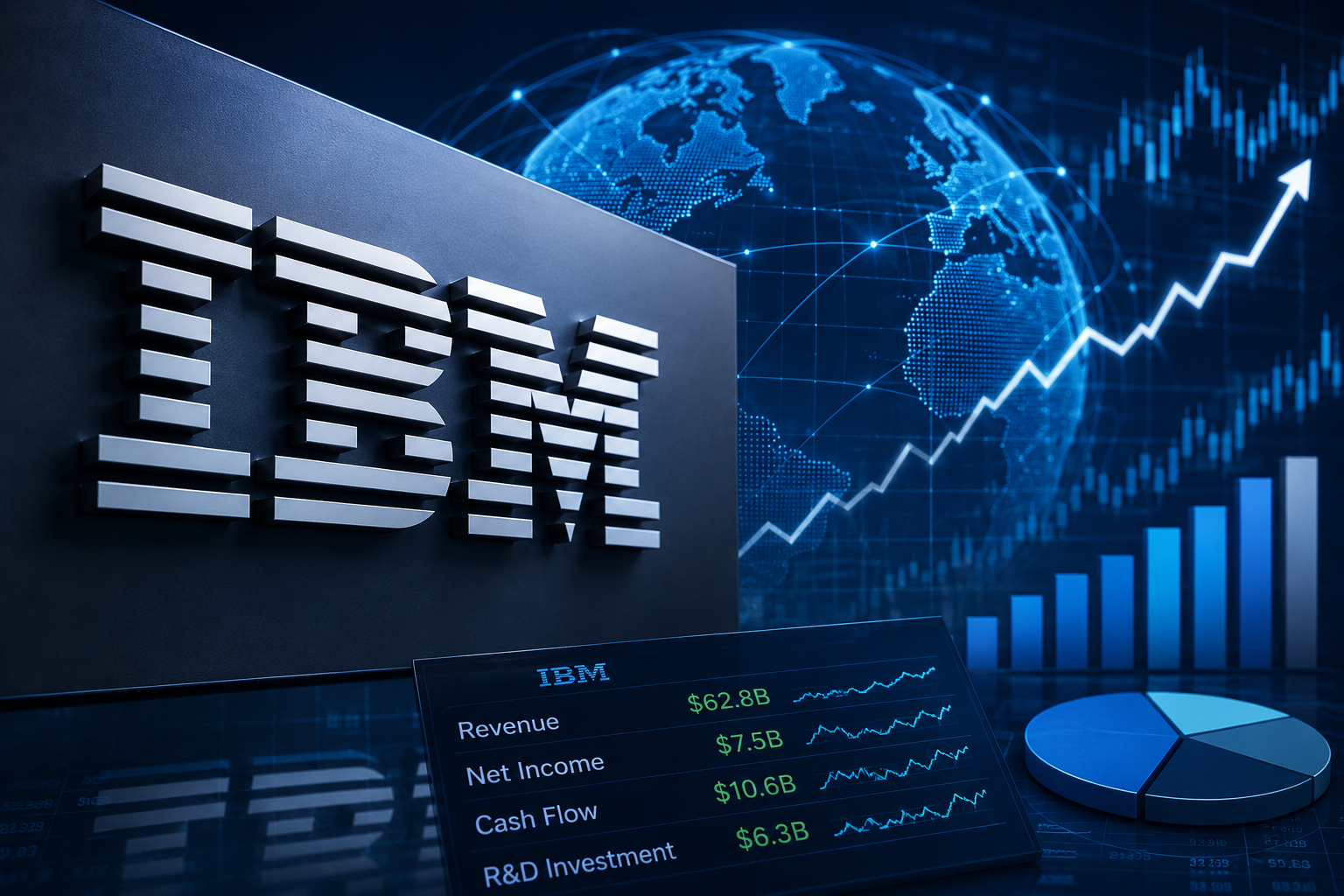
Quick Summary: International Business Machines Corporation (NYSE: IBM), commonly known as IBM or Big Blue, is an Armonk, New York based technology company and one of the oldest continuously operating computing firms in the world. Founded in 1911 as the Computing-Tabulating-Recording Company, IBM today focuses on hybrid cloud, enterprise software, consulting, and artificial intelligence, built around brands such as Red Hat, watsonx, and its long running IBM Z mainframe line.
IBM reported full year 2025 revenue of approximately $67.5 billion, with fourth quarter revenue of $19.7 billion, up 12 percent year over year, and net income surging 93 percent to $5.6 billion in that quarter. The company’s generative AI book of business grew from about $5 billion to more than $12.5 billion during 2025. As of early July 2026, IBM trades around $287 per share, giving the company a market capitalization near $272 billion. IBM pays a quarterly dividend of $1.69 per share and has raised its payout for 31 consecutive years, making it one of the more reliable dividend growth stocks in large cap technology.
Legal NameInternational Business Machines Corporation
Ticker SymbolIBM (NYSE)
FoundedJune 16, 1911
HeadquartersArmonk, New York, USA
Chairman, President and CEOArvind Krishna
IndustryEnterprise technology, hybrid cloud, AI
FY2025 RevenueApproximately $67.5 billion
Q1 2026 Revenue$15.9 billion
Approx. Market Cap$272 billion (July 2026)
Quarterly Dividend$1.69 per share
Dividend Streak31 consecutive years of increases
EmployeesApproximately 280,000 to 300,000 worldwide
What Is International Business Machines?
International Business Machines Corporation, almost universally known by its initials IBM, is a global technology company that provides hybrid cloud infrastructure, enterprise software, consulting services, and artificial intelligence platforms to businesses and governments. IBM operates in more than 175 countries and counts a large majority of the Fortune 500 among its clients, serving industries such as banking, insurance, healthcare, government, and telecommunications that depend on secure, reliable, large scale computing.
Once known primarily as a hardware manufacturer, IBM has spent much of the past two decades transforming into a software and services company centered on hybrid cloud, meaning technology that lets clients run workloads across a mix of on premises data centers and multiple public clouds. The 2019 acquisition of Red Hat, the open source software company behind Linux based enterprise platforms, remains the largest deal in IBM’s history and sits at the core of that strategy.
More recently, IBM has positioned itself as an enterprise focused alternative to consumer facing AI companies, emphasizing tools that help large organizations deploy artificial intelligence responsibly across hybrid environments through its watsonx platform, while continuing to sell IBM Z mainframes that still process a significant share of the world’s most sensitive financial and government transactions.
Company History
IBM’s roots trace back to June 16, 1911, when several companies that made record keeping equipment, including scales, time clocks, and tabulating machines, merged to form the Computing Tabulating Recording Company (CTR) in New York state. Under the leadership of Thomas J. Watson Sr., who joined as general manager in 1914 and became president in 1915, the company grew steadily and was renamed International Business Machines Corporation in 1924, reflecting its increasingly global ambitions.
Through the mid 20th century, IBM became synonymous with corporate computing, producing punch card tabulators, early electronic computers, and eventually the IBM System/360 mainframe family in 1964, a landmark product line that standardized enterprise computing for decades. In 1981, IBM launched the IBM Personal Computer, which helped establish the architecture that would define the PC industry for years, though IBM later exited the PC hardware business entirely, selling its personal computing division to Lenovo in 2005.
The 1990s brought a severe crisis, as IBM posted major losses amid the shift away from mainframe dependent computing, prompting the board to bring in outsider Louis V. Gerstner Jr. as CEO in 1993. Gerstner is widely credited with orchestrating one of the most studied corporate turnarounds in business history, refocusing IBM on services and enterprise solutions rather than hardware alone.
In the 2010s and 2020s, IBM continued reshaping its portfolio for the cloud and AI era, spinning off its managed infrastructure services business as an independent public company, Kyndryl, in 2021, while doubling down on software through the 2019 acquisition of Red Hat for $34 billion, the largest transaction in IBM’s history. Under CEO Arvind Krishna, IBM has pursued additional acquisitions, including the 2026 purchase of data streaming company Confluent for roughly $11.6 billion, further building out its hybrid cloud and data platform capabilities as the company leans further into enterprise artificial intelligence.
Founders
IBM does not trace to a single founder in the way many modern technology companies do. Instead, the company originated from the 1911 merger of several existing manufacturers of record keeping and measurement equipment, brought together by financier Charles Ranlett Flint, who is often referred to as the founder of the Computing Tabulating Recording Company, IBM’s predecessor.
Charles Ranlett Flint, a businessman known for organizing corporate mergers, orchestrated the 1911 combination of the Tabulating Machine Company, the International Time Recording Company, and the Computing Scale Company into CTR.
Herman Hollerith, an inventor whose punch card tabulating technology, originally developed for the U.S. Census, formed the core intellectual property of the Tabulating Machine Company, one of CTR’s founding businesses.
Thomas J. Watson Sr., though not present at the 1911 founding, joined in 1914 and is widely regarded as the executive most responsible for shaping the company’s culture and growth strategy, eventually renaming it International Business Machines in 1924.
CEO
Arvind Krishna has served as IBM’s Chairman, President, and Chief Executive Officer since April 2020, having been named CEO in January 2020 and taking the role that April, succeeding Ginni Rometty. Krishna joined IBM in 1990 at its Thomas J. Watson Research Center immediately after completing his doctorate, spending his entire multi decade career at the company before rising to the top job.
Before becoming CEO, Krishna served as Senior Vice President for Cloud and Cognitive Software and led IBM Research, and he was widely credited as the principal architect behind IBM’s $34 billion acquisition of Red Hat in 2019, the largest deal in company history. Since taking over, Krishna has overseen the 2021 spin off of Kyndryl, steered the company’s pivot toward hybrid cloud and generative AI through the watsonx platform, and pursued acquisitions such as the 2026 purchase of Confluent to expand IBM’s data and software capabilities. Under his leadership, IBM’s generative AI book of business grew from roughly $5 billion to more than $12.5 billion during 2025 alone, and fourth quarter 2025 net income rose 93 percent year over year to $5.6 billion.
Headquarters
IBM is headquartered in Armonk, New York, a suburban town roughly 30 miles north of New York City, where the company has maintained its principal executive offices for decades. IBM operates a vast global research and development network beyond its headquarters, including IBM Research, one of the largest corporate research organizations in the world, with facilities across a dozen countries. The company also maintains a major presence in cities such as Austin, Texas, and Poughkeepsie, New York, the latter historically tied to IBM’s mainframe manufacturing and development operations, along with extensive operations across Europe, Asia, and Latin America supporting its 175 plus country footprint.
Business Segments
IBM reports its results across four primary segments:
Software: IBM’s largest and fastest growing segment, encompassing hybrid cloud platforms built on Red Hat, data and AI tools including watsonx, automation software, and enterprise security products.
Consulting: Advisory, systems integration, and implementation services that help enterprise clients modernize technology, migrate to hybrid cloud, and deploy AI, often bundled alongside IBM’s own software and hardware.
Infrastructure: Hardware products, most notably the IBM Z mainframe family and Power based servers, along with related infrastructure software and support services.
Financing: A smaller segment that provides lease and loan financing to help clients acquire IBM hardware, software, and services.
Products and Services
IBM’s portfolio spans decades old hardware franchises alongside newer cloud and AI platforms.
Product or Platform
Segment
Function
Red Hat OpenShift and Enterprise Linux
Software
Hybrid cloud application platform and enterprise operating system
watsonx
Software
Enterprise generative AI and machine learning platform
IBM Z
Infrastructure
Mainframe systems for mission critical, high volume transaction processing
Power Systems
Infrastructure
Servers for enterprise workloads including SAP and AI inferencing
Confluent (data streaming)
Software
Real time data streaming platform, acquired in 2026
IBM Consulting
Consulting
Technology strategy, systems integration, and AI implementation services
IBM Cloud
Software and Infrastructure
Public and hybrid cloud infrastructure services
IBM Security (QRadar and related tools)
Software
Threat detection, identity, and data security products
IBM Quantum
Infrastructure and Research
Quantum computing hardware, software, and cloud access
IBM Z, the company’s flagship mainframe line, continues to post strong growth driven by clients upgrading to the newer z17 generation of systems, with the segment posting double digit revenue increases in recent quarters. IBM has also committed roughly $10 billion over five years to expand its quantum computing research and manufacturing, betting that quantum systems will eventually become commercially important for enterprise clients working on complex optimization and materials science problems.
Revenue Breakdown
The chart below shows IBM’s total revenue over the past several fiscal years, illustrating the company’s return to steady growth following the 2021 Kyndryl spin off.
IBM total revenue by fiscal year. 2021 figure reflects continuing operations following the Kyndryl spin off announcement. Source: company financial filings.
Full year 2025 revenue reached approximately $67.5 billion, with growth accelerating through the year as Software led the way. Fourth quarter 2025 revenue alone was $19.7 billion, up 12 percent year over year, with software revenue up 14 percent in that quarter. First quarter 2026 revenue continued the trend at $15.9 billion, up 9.5 percent, with Software revenue of $7.1 billion, up more than 11 percent, Consulting revenue of $5.3 billion, up 4 percent, and Infrastructure revenue of $3.3 billion, up more than 15 percent on strong IBM Z mainframe demand.
By segment, Software has become IBM’s largest and most profitable growth engine, with Red Hat hybrid cloud revenue and Data related products, boosted by the newly acquired Confluent business, both posting double digit growth. Consulting has grown more modestly but carries a substantial backlog, with generative AI related work representing roughly 30 percent of that backlog. Infrastructure revenue tends to move in cycles tied to new IBM Z mainframe generations, and the current z17 product cycle has driven strong recent growth in that segment even though management expects a modest full year infrastructure revenue decline as the current hardware cycle matures.
Financial Performance
The table below summarizes recent quarterly and annual financial results.
Period
Total Revenue
YoY Growth
Net Income
Full Year 2024
$62.8 billion
Roughly 1 to 3%
Approximately $6.0 billion
Full Year 2025
$67.5 billion
Approximately 7%
Higher year over year, boosted by Q4
Q4 2025 (quarter)
$19.7 billion
12%
$5.6 billion
Q1 2026 (quarter)
$15.9 billion
9.5%
$1.2 billion
Approximate trend in IBM quarterly revenue across recent quarters, showing the seasonal fourth quarter peak typical of IBM’s business. Source: company financial filings.
IBM’s profitability has improved meaningfully under its hybrid cloud and AI focused strategy, with operating pre tax margin expanding across recent quarters as higher margin software revenue makes up a larger share of the overall business. First quarter 2026 operating non GAAP pre tax income rose 23 percent year over year to $2.1 billion, with operating diluted earnings per share of $1.91, up 19 percent, while free cash flow reached $2.2 billion, up 13 percent. Management has guided for more than 5 percent constant currency revenue growth for full year 2026, alongside an expected increase of roughly $1 billion in year over year free cash flow.
The company has also pursued significant merger and acquisition activity to accelerate growth, closing its roughly $11.6 billion acquisition of data streaming company Confluent in the first quarter of 2026, which management expects to contribute meaningfully to Software and Data segment revenue growth going forward. IBM has cited cumulative productivity savings of $4.5 billion since 2023 from AI enabled internal transformation, with an additional $1 billion in savings expected during 2026.
Stock Information
Metric
Approximate Value
Exchange
New York Stock Exchange
Ticker
IBM
Recent share price
Around $287
Approximate market capitalization
$272 billion
52 week range
Roughly $212 to $332
Trailing P/E ratio
Approximately 24 to 26
Beta
Approximately 0.67, historically lower volatility than the broader market
Next earnings report
Expected around July 22, 2026
IBM shares reached an all time closing high of roughly $329 in early June 2026 before pulling back somewhat, and the stock remains up meaningfully from its 52 week low of about $212 reached in mid May 2026. Despite the strong percentage gain, some analysts have noted that IBM’s rally has still lagged the broader technology industry’s growth over the same period, framing the stock as a comparatively overlooked way to gain exposure to enterprise AI adoption, since its core hybrid cloud and consulting businesses sit at the center of how large regulated companies actually deploy artificial intelligence in production.
Wall Street price targets for IBM have generally clustered between roughly $270 and $335 per share heading into the company’s next earnings report, with many analysts pointing to accelerating software growth, a large and growing generative AI book of business, and continued dividend reliability as reasons for optimism, while some caution that IBM’s Consulting segment growth remains comparatively modest and that Infrastructure revenue can be volatile around mainframe product cycles.
Dividends
IBM is one of the most established dividend paying stocks in large cap technology, having increased its dividend for 31 consecutive years, a streak that places the company among the small group of long tenured dividend growth stocks sometimes referred to as dividend aristocrats. IBM currently pays a quarterly dividend of $1.69 per share, equal to $6.76 annualized, providing a dividend yield of roughly 2.3 percent at recent share prices, notably higher than the yields typically offered by faster growing technology peers.
The company’s long dividend history reflects its transition from a high growth hardware business decades ago into a more mature, cash generative enterprise software and services company today, one that management has consistently prioritized returning capital to shareholders alongside continued investment in acquisitions such as Red Hat and Confluent. IBM’s free cash flow generation, which management expects to grow by roughly $1 billion year over year in 2026, continues to provide support for both the dividend and ongoing business development activity.
Competitors
IBM competes across several distinct enterprise technology categories, meaning its rival set varies considerably depending on the specific business line.
Competitor
Ticker
Primary Overlap
Microsoft
MSFT
Cloud computing, enterprise software, AI platforms
Enterprise resource planning and business software
Dell Technologies
DELL
Enterprise servers and infrastructure hardware
Salesforce
CRM
Cloud based enterprise applications
Microsoft and Amazon represent IBM’s most significant competitive pressure in cloud computing, given their vastly larger public cloud market share, though IBM differentiates itself by focusing on hybrid cloud deployments for regulated industries that must keep sensitive workloads partly on premises, a positioning that plays to the strength of Red Hat OpenShift and IBM’s decades of enterprise systems experience. In consulting, Accenture stands as IBM’s closest direct competitor, while in mainframe and enterprise hardware, IBM Z faces comparatively limited direct competition given the specialized nature of that market.
Recent News
Confluent acquisition closed: IBM completed its approximately $11.6 billion acquisition of data streaming company Confluent in the first quarter of 2026, a deal management expects to contribute significantly to Software and Data segment growth in coming years.
Strong Q1 2026 results: Revenue grew 9.5 percent to $15.9 billion, beating consensus estimates, with double digit growth in both Software and Infrastructure, and IBM maintained its full year guidance of more than 5 percent constant currency revenue growth.
Quantum computing investment: IBM committed roughly $10 billion over five years to expand quantum computing research and manufacturing, aligning with recent U.S. policy interest in advancing domestic quantum technology.
Generative AI book of business surpasses $12.5 billion: IBM’s cumulative generative AI related bookings more than doubled during 2025, reflecting rapid enterprise adoption of the company’s AI consulting and watsonx software offerings.
New marketing and agency partnerships: IBM selected Stagwell as its lead creative partner and named Omnicom Media as its global media agency of record, part of a broader refresh of the company’s brand and marketing strategy.
IBM Z z17 product cycle: The newest generation of IBM’s flagship mainframe continues to drive strong Infrastructure segment growth, with IBM Z revenue up sharply in recent quarters as enterprise clients upgrade their systems.
Frequently Asked Questions
What does IBM do?
IBM provides hybrid cloud infrastructure, enterprise software including Red Hat and watsonx, consulting services, and hardware such as IBM Z mainframes to businesses and governments around the world.
Who founded IBM and when?
IBM originated from the 1911 merger of several equipment manufacturers into the Computing Tabulating Recording Company, organized by financier Charles Ranlett Flint. The company was renamed International Business Machines in 1924 under the leadership of Thomas J. Watson Sr.
Who is the CEO of IBM?
Arvind Krishna has served as Chairman, President, and Chief Executive Officer since April 2020.
Where is IBM headquartered?
IBM is headquartered in Armonk, New York.
Is IBM profitable?
Yes. IBM is solidly profitable, with expanding operating margins driven by growth in its higher margin Software segment, and the company generates substantial free cash flow that supports both its dividend and continued acquisitions.
Does IBM pay a dividend?
Yes. IBM pays a quarterly dividend, currently $1.69 per share, and has raised its dividend for 31 consecutive years, making it one of the more established dividend growth stocks in the technology sector.
Who are IBM’s main competitors?
Key competitors include Microsoft, Amazon Web Services, and Oracle in cloud computing, Accenture in consulting, and SAP and Salesforce in enterprise software, though the specific competitive overlap depends on the business segment in question.
What happened to IBM’s PC business?
IBM sold its personal computer division to Lenovo in 2005, exiting the PC hardware business entirely to focus on higher margin software, services, and enterprise hardware such as mainframes.
What is Kyndryl and why was it spun off from IBM?
Kyndryl is IBM’s former managed infrastructure services business, spun off as an independent public company in 2021 so IBM could focus more directly on higher growth hybrid cloud and software offerings.
Is IBM stock a good investment?
This is a personal financial decision that depends on individual goals, risk tolerance, and time horizon. IBM offers steady dividend growth, improving software led profitability, and a growing AI business, but its Consulting segment growth has been comparatively modest and its stock has, at times, lagged broader technology sector gains. Readers should consult a licensed financial advisor before making investment decisions, since this article is educational and not personalized investment advice.
Sources include IBM SEC filings and press releases, company earnings call transcripts and investor communications, and public market data providers including Yahoo Finance, CNBC, TradingView, and Morningstar, current as of early July 2026. Figures are subject to change following future earnings reports and market activity.