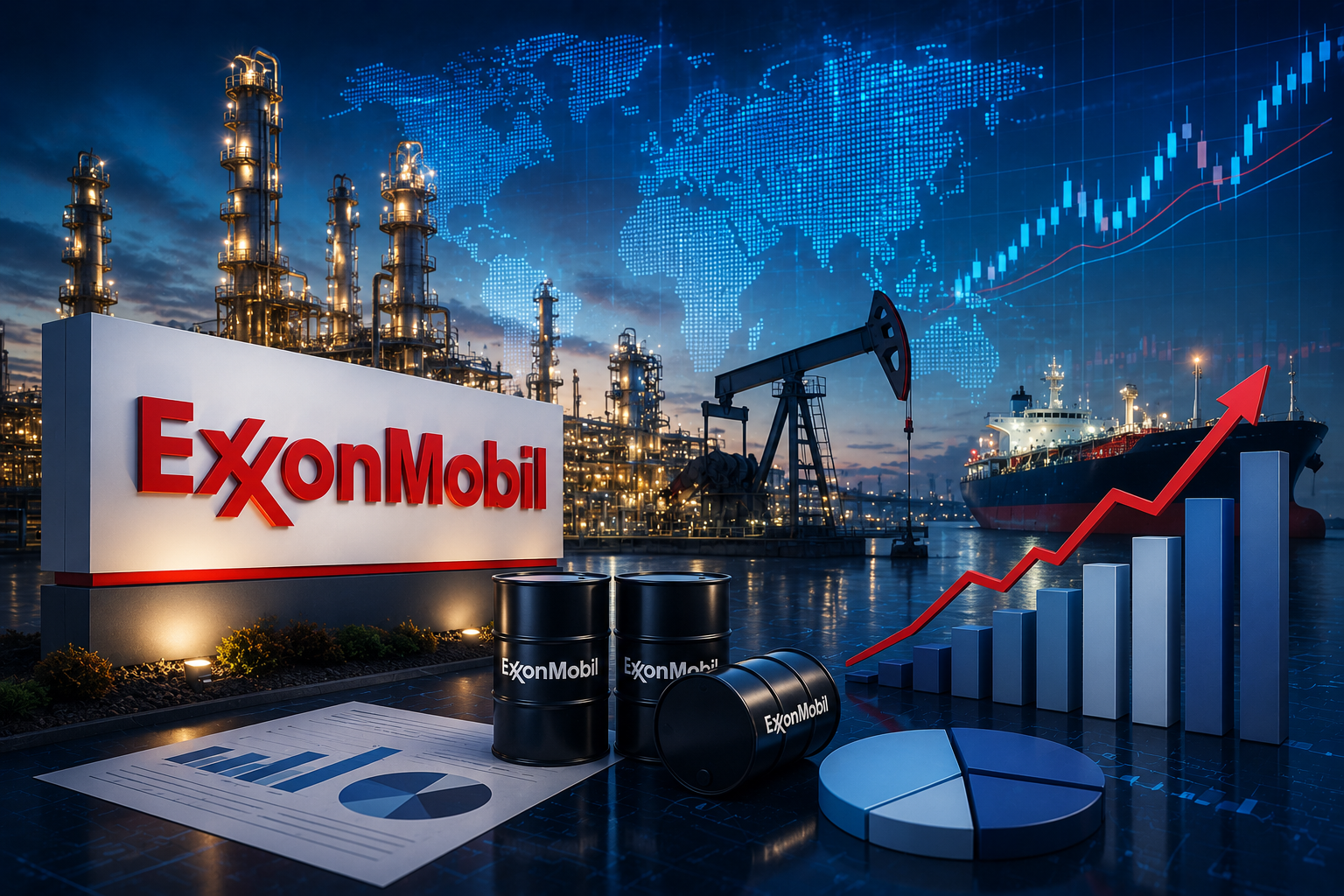
ExxonMobil (NYSE: XOM) is a Spring, Texas based integrated oil and gas major, and the largest direct descendant of John D. Rockefeller’s Standard Oil.
The stock trades near $137, giving it a market cap of roughly $568 billion, well off its 52 week high of $176.41.
Full year 2025 revenue was $323.9 billion, with net income attributable to ExxonMobil of $28.8 billion and diluted EPS of $6.70.
On July 1, 2026, the company completed a redomiciliation from New Jersey to Texas, forming a new parent company called ExxonMobil Holdings Corporation, still trading under the ticker XOM.
Darren Woods has served as Chairman and CEO since January 2017.
ExxonMobil has raised its dividend for 43 consecutive years, currently paying $1.03 per share quarterly, and remains one of the largest dividend payers in the S&P 500.
Main competitors include Chevron, Shell, BP, TotalEnergies, and ConocoPhillips.
Quick Facts
TickerNYSE: XOM
Founded1870 (as Standard Oil)
HeadquartersSpring, Texas
CEODarren Woods
Employees~58,000
Market Cap~$568 billion
FY2025 Revenue$323.9 billion
FY2025 Net Income$28.8 billion
Dividend Yield~3.0%
P/E Ratio (TTM)~23x
What Is ExxonMobil?
ExxonMobil is one of the world’s largest publicly traded integrated energy and petrochemical companies. It explores for, produces, refines, transports, and sells crude oil, natural gas, petroleum products, and petrochemicals across the globe, selling fuels and lubricants under the Exxon, Esso, and Mobil brand names.
As an “integrated” oil major, ExxonMobil operates across the entire energy value chain, from drilling wells (Upstream) to refining crude into fuels (Energy Products) to manufacturing plastics and chemicals (Chemical Products) to producing lubricants, waxes, and specialty materials (Specialty Products). The company also has a growing Low Carbon Solutions business focused on carbon capture and storage, hydrogen, and lithium, positioning it to participate in the energy transition while remaining primarily an oil and gas producer. As of mid-2026, ExxonMobil trades under a newly formed Texas parent company, ExxonMobil Holdings Corporation, following a corporate redomiciliation from New Jersey.
Company History
ExxonMobil’s roots trace back to 1870, when John D. Rockefeller founded Standard Oil in Ohio, which grew into the dominant force in the American oil industry. In 1911, the U.S. Supreme Court ordered Standard Oil broken up under antitrust law, splitting it into more than 30 separate companies. Two of the largest descendants, Standard Oil of New Jersey (which later became Exxon) and Standard Oil of New York (which later became Mobil), continued to operate as major independent oil companies for most of the 20th century.
In 1999, Exxon and Mobil merged in what was, at the time, the largest corporate merger in history, reuniting the two Standard Oil descendants into Exxon Mobil Corporation. The combined company became one of the world’s most valuable and profitable corporations over the following two decades, at times ranking as the largest company in the world by market capitalization.
In recent years, ExxonMobil has shifted its operational footprint decisively toward Texas, moving its headquarters from Irving to a large new campus in Spring, just north of Houston, in 2022. That shift culminated on July 1, 2026, when the company completed a redomiciliation merger, changing its state of incorporation from New Jersey to Texas and forming a new publicly traded parent company, ExxonMobil Holdings Corporation, while keeping the familiar XOM ticker on the New York Stock Exchange.
Founders
ExxonMobil does not have a single modern founder in the way many newer companies do, since it is the product of a 1999 merger between two century-old descendants of Standard Oil. Its ultimate historical founder is widely recognized as John D. Rockefeller.
John D. RockefellerFounded Standard Oil in 1870, the common ancestor of both Exxon and Mobil
Henry FlaglerCo-founder of Standard Oil, key early business partner of Rockefeller
Following the 1911 breakup of Standard Oil, Exxon (as Standard Oil of New Jersey) and Mobil (as Standard Oil of New York) developed as independent companies for nearly nine decades before their 1999 merger created the modern ExxonMobil.
CEO
Darren W. Woods has served as Chairman and CEO of ExxonMobil since January 1, 2017, succeeding Rex Tillerson, who left the company to become U.S. Secretary of State. Woods joined Exxon in 1992 as a planning analyst after earning an electrical engineering degree from Texas A&M and an MBA from Northwestern University’s Kellogg School of Management. Prior to becoming CEO, he ran the company’s refining and chemical divisions.
Under Woods, ExxonMobil has pursued a strategy centered on the Permian Basin and Guyana, completed its roughly $60 billion acquisition of Pioneer Natural Resources, delivered a multibillion dollar structural cost reduction program, and led the company’s move to redomicile in Texas.
ExxonMobil’s CEOs since the 1999 Exxon-Mobil merger have been:
Lee Raymond (1999 to 2005)
Rex Tillerson (2006 to December 2016)
Darren Woods (January 2017 to present)
Headquarters
ExxonMobil is headquartered in Spring, Texas, on a large corporate campus just north of Houston that the company moved into in 2015. The move to Texas has been decades in the making, following an earlier relocation of operational headquarters from New York to Irving, Texas, in the 1990s. As of 2026, an estimated 75% of ExxonMobil’s US-based workforce is located in Texas, and the company completed its legal redomiciliation to the state on July 1, 2026.
Business Segments
ExxonMobil reports its results across four primary business segments:
Upstream: Exploration for and production of crude oil and natural gas, including flagship assets in the Permian Basin and offshore Guyana. This segment is typically ExxonMobil’s largest earnings driver.
Energy Products: Refining of crude oil into fuels, along with aromatics, catalysts, and licensing services, this segment was formerly known as “Downstream.”
Chemical Products: Manufacturing and sale of olefins, polyolefins, and other petrochemical intermediates used to make plastics and industrial materials.
Specialty Products: Finished lubricants, basestocks, waxes, synthetics, elastomers, and resins sold to industrial and consumer customers.
ExxonMobil also invests in a separate Low Carbon Solutions business spanning carbon capture and storage, hydrogen, lower-emission fuels, and lithium extraction, though this remains a small share of overall earnings relative to the four core segments.
Products & Services
Crude oil and natural gas production: ExxonMobil’s core Upstream business, with major growth engines in the Permian Basin and Guyana.
Fuels: Gasoline, diesel, and jet fuel sold under the Exxon, Esso, and Mobil brand names at retail stations worldwide.
Petrochemicals: Olefins and polyolefins used to manufacture plastics, packaging, and industrial products.
Lubricants and specialty products: Mobil 1 motor oil and other lubricants, waxes, and synthetic materials sold to consumers and industrial customers.
Liquefied natural gas (LNG): Including the Golden Pass LNG export project, expected to significantly expand ExxonMobil’s US LNG export capacity.
Low carbon solutions: Carbon capture and storage, hydrogen, lower-emission fuels, Proxxima resin systems, carbon materials, low-carbon data center power, and lithium.
Revenue Breakdown
ExxonMobil’s revenue is dominated by its Energy Products segment, which includes fuel sales, though its Upstream segment typically contributes the largest share of profit given its higher margins.
FY2025 Revenue by Segment (approx., $323.9B total)
Segment shares are approximate, based on ExxonMobil’s FY2025 10-K disclosures. Figures exclude corporate and intersegment eliminations.
Revenue by earnings contribution
While Energy Products generates the most top-line revenue due to the sheer volume of refined fuel sales, Upstream typically delivers a disproportionate share of ExxonMobil’s profit because oil and gas production carries much higher margins than refining. In Q1 2026, for example, Upstream alone earned $5.7 billion while Energy Products posted a loss due to derivative and Middle East supply disruption effects.
Revenue trend
Annual Revenue, FY2022 to FY2025 ($ billions)
Revenue has declined from 2022’s post-pandemic energy price spike as oil and gas prices normalized. Source: ExxonMobil 10-K filings.
Financial Performance
ExxonMobil’s earnings closely track global oil, gas, and refining margins, making its results more cyclical than typical consumer or technology stocks. Full year 2025 earnings declined from the record levels of 2022 and 2023 as commodity prices normalized, though the company continued to generate substantial cash flow and industry-leading shareholder returns.
Key annual financial results, GAAP basis
Metric
FY2023
FY2024
FY2025
Revenue
$344.6B
$349.6B
$323.9B
Net income attributable to ExxonMobil
$36.01B
$33.68B
$28.84B
Diluted EPS
$8.89
$7.84
$6.70
Cash flow from operations
$55.4B
$55.0B
$52.0B
Shareholder distributions
$32.4B
$36.3B
$37.2B
Most recent quarterly results (Q1 2026 vs Q1 2025)
Metric
Q1 2025
Q1 2026
Change
Revenue and other income
$83.1B
$85.1B
+2.4%
Net income (GAAP)
$7.7B
$4.2B
-45%
Diluted EPS (GAAP)
$1.76
$1.00
-43%
Earnings excl. identified items
$7.6B
$4.9B
-36%
Cash flow from operations
$13.0B
$8.7B
-33%
Shareholder distributions
$9.1B
$9.2B
+1%
The Q1 2026 decline was driven largely by unfavorable derivative mark-to-market effects and Middle East supply disruptions that hit the Energy Products segment, alongside higher depreciation expense, even as Upstream volumes from the Permian Basin and Guyana continued to grow. Management has emphasized that earnings excluding one-time timing effects and identified items actually rose year over year, underscoring the underlying strength of the business despite volatile headline GAAP results.
Net Income Attributable to ExxonMobil, FY2023 to FY2025 ($ billions)
Net income has declined from 2023’s elevated levels as oil, gas, and chemical margins normalized from post-pandemic highs. Source: ExxonMobil 10-K filings.
Stock Information
ExxonMobil shares trade on the New York Stock Exchange under the ticker XOM. Following the July 1, 2026 redomiciliation, shares of the newly formed ExxonMobil Holdings Corporation began trading under the same ticker on July 2, 2026, through a seamless one-for-one share exchange that left shareholders’ economic ownership unchanged.
Last price$137.09
52-week range$105.53 to $176.41
Market cap~$568B
P/E (TTM)~23.1x
EPS (TTM)$5.94
Beta0.16
Debt-to-capital ratio~14%
Next earnings (est.)Late July 2026
With a low beta near 0.16, XOM has historically moved less dramatically than the broader stock market, reflecting its status as a large, cash generative, dividend paying blue chip rather than a high growth momentum stock. The stock trades at a modest premium to some international peers such as Shell and TotalEnergies, which analysts generally attribute to ExxonMobil’s stronger balance sheet, higher-return asset base in the Permian and Guyana, and industry-leading cost reduction program.
Dividends
ExxonMobil is one of the most reliable dividend payers in the US stock market, having increased its annual dividend for 43 consecutive years, a streak that qualifies it as a Dividend Aristocrat. The company currently pays a quarterly dividend of $1.03 per share, having raised the payout 4% in its most recent increase.
Quarterly dividend$1.03/share
Dividend yield (approx.)~3.0%
Consecutive increases43 years
FY2025 dividends paid$17.2 billion
In addition to its dividend, ExxonMobil has committed to repurchasing $20 billion of shares in 2026, following $20 billion of buybacks in 2025, as part of a broader strategy to return the bulk of its free cash flow to shareholders. Combined dividends and buybacks totaled $37.2 billion in 2025, among the largest shareholder distribution totals of any company in the S&P 500.
Competitors
ExxonMobil competes with other integrated oil majors and national oil companies across exploration, refining, and chemicals.
Selected ExxonMobil competitors by category
Company
Category
Overlap with ExxonMobil
Chevron
Integrated oil and gas major
Direct US competitor across Upstream production, including the Permian Basin, and Downstream refining
Shell
Integrated oil and gas major
Global competitor in oil, gas, LNG, and chemicals, with a larger relative focus on trading and LNG
BP
Integrated oil and gas major
Global upstream and downstream competitor, historically more exposed to European operations
TotalEnergies
Integrated oil and gas major
French based global competitor with a larger relative renewables and LNG portfolio
ConocoPhillips
Exploration and production
Major US upstream-focused competitor without ExxonMobil’s refining and chemicals operations
Saudi Aramco
National oil company
The world’s largest oil producer by volume, competing globally in crude oil supply
ExxonMobil’s scale, integration across the full energy value chain, and cost leadership give it an advantage many peers cannot easily replicate, though its stock still moves largely in tandem with global oil, gas, and refining prices, exposing it to the same commodity cycle risks as the rest of the industry.
Recent News
July 1 to 2, 2026
ExxonMobil completed its redomiciliation merger, moving its legal domicile from New Jersey to Texas and forming a new publicly traded parent, ExxonMobil Holdings Corporation, which began trading under the existing XOM ticker on the NYSE on July 2, 2026.
June 23, 2026
The US Supreme Court revived a lawsuit against ExxonMobil related to Cuban asset seizures, adding to the company’s ongoing legal exposure tied to historical operations.
May 29, 2026
ExxonMobil shareholders approved the Texas redomiciliation at the company’s annual meeting, alongside other governance matters, following a public debate over proxy advisor recommendations.
April 30, 2026
ExxonMobil reported first quarter 2026 earnings of $4.2 billion, down from $7.7 billion a year earlier, citing unfavorable derivative timing effects and Middle East supply disruptions, while maintaining its dividend growth streak and $20 billion 2026 buyback plan.
January 30, 2026
ExxonMobil closed out 2025 with full year earnings of $28.8 billion and record full-year global refining throughput since the 1999 Exxon-Mobil merger, while distributing $37.2 billion to shareholders.
Frequently Asked Questions
Is ExxonMobil stock a buy right now?
That depends on individual goals, risk tolerance, and views on future oil and gas prices, since ExxonMobil’s earnings are closely tied to commodity cycles. The stock offers a solid dividend track record and strong cash generation, balanced against exposure to volatile energy markets. This article is for informational purposes only and is not investment advice, always do your own research or consult a licensed financial advisor before investing.
Who owns ExxonMobil?
ExxonMobil is a publicly traded company owned by its shareholders, primarily large institutional investors such as index funds and asset managers, alongside millions of individual retail investors. No single family or founder controls the company today.
Does ExxonMobil pay a dividend?
Yes. ExxonMobil has increased its dividend annually for 43 consecutive years, currently paying $1.03 per share quarterly, making it one of the most consistent dividend payers among large US companies.
Who is the current CEO of ExxonMobil?
Darren W. Woods has been Chairman and CEO of ExxonMobil since January 2017. He is a nearly three-decade company veteran who previously led ExxonMobil’s refining and chemical divisions.
How does ExxonMobil make money?
ExxonMobil earns revenue across four main segments: Upstream (oil and gas exploration and production), Energy Products (refining and fuel sales), Chemical Products (petrochemicals), and Specialty Products (lubricants and specialty materials). Upstream typically contributes the largest share of profit due to its higher margins.
Why did ExxonMobil change its name to ExxonMobil Holdings Corporation?
On July 1, 2026, ExxonMobil completed a redomiciliation merger that moved its legal home from New Jersey to Texas, where the vast majority of its operations and workforce are already based. The move created a new Texas-incorporated parent company, ExxonMobil Holdings Corporation, through a one-for-one share exchange that left shareholder ownership unchanged. Shares continue trading under the familiar XOM ticker.
Is ExxonMobil the same company as Standard Oil?
ExxonMobil is the direct descendant of Standard Oil, the company John D. Rockefeller founded in 1870. After Standard Oil was broken up by antitrust regulators in 1911, two of its successor companies, Exxon and Mobil, operated independently for most of the 20th century before merging back together in 1999 to form ExxonMobil.
This article is for general informational purposes only and does not constitute financial, investment, tax, or legal advice. Stock prices, financial figures, and company details are based on publicly available data as of the update date shown above and may have changed since publication. Always verify current figures with official sources, such as ExxonMobil’s investor relations site or SEC filings, and consult a licensed financial advisor before making investment decisions.