Quick summary: Oklo Inc. (NYSE: OKLO) is an advanced nuclear technology company based in Santa Clara, California, that is building small fast fission reactors called Aurora powerhouses to sell electricity and heat to data centers, industrial sites, and government customers. Oklo was founded in 2013 by Jacob DeWitte and Caroline Cochran and became a public company in May 2024 through a merger with Sam Altman’s special purpose acquisition company, AltC Acquisition Corp.
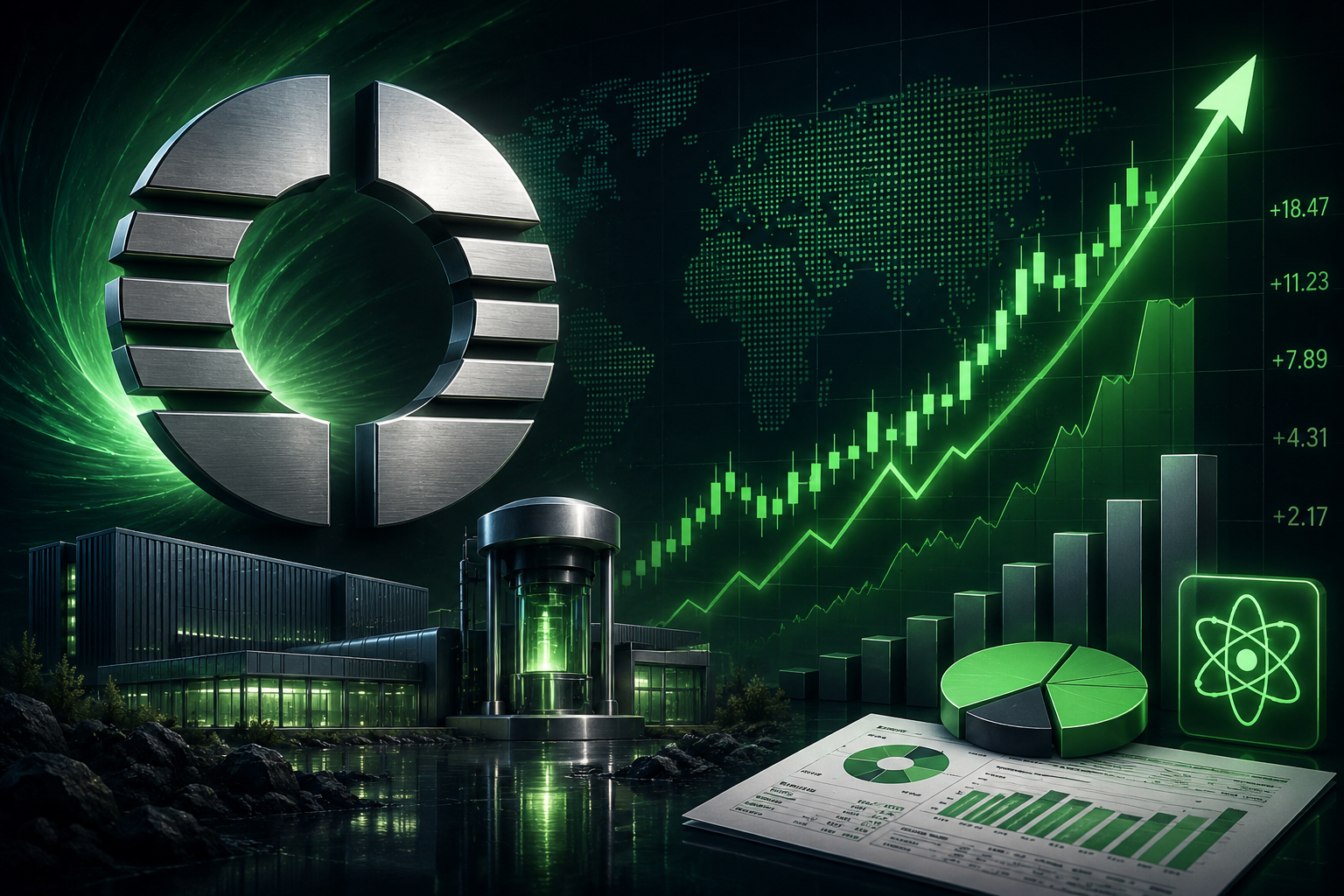
As of early July 2026, OKLO trades in the low fifty dollar range with a market capitalization of roughly nine billion dollars, well off its all time high near one hundred ninety four dollars set in October 2025. The company is still pre revenue, reported a first quarter 2026 net loss of about thirty three million dollars, and held approximately two and a half billion dollars in cash and marketable securities at the end of that quarter. Oklo does not pay a dividend and is not expected to for the foreseeable future.
This guide covers Oklo’s history, leadership, business segments, financial performance, stock data, dividend policy, competitors, and the latest company news, along with charts and a frequently asked questions section built for investors researching the stock.
Jacob DeWitte, co founder and Chief Executive Officer
COO
Caroline Cochran, co founder and Chief Operating Officer
Headquarters
Santa Clara, California, United States
Industry
Advanced nuclear power and fuel recycling technology
Public listing method
Merger with AltC Acquisition Corp, completed May 9, 2024
Flagship product
Aurora powerhouse, a compact liquid metal fast reactor
Employees
Roughly 200, according to third party stock data providers
Revenue status
Pre revenue as of the most recent quarterly report
Dividend
None paid
Approximate market cap
About 9 billion dollars
Figures such as employee count, market cap, and share price change frequently. See the Stock Information section below for the latest trading data referenced in this article.
What Is Oklo?
Oklo Inc. is an American advanced nuclear technology company that designs, builds, and plans to operate small fast fission power plants. Rather than selling reactors outright, Oklo’s business model is built around owning and running its plants and selling the electricity and heat they produce directly to customers under long term power agreements, similar to how a utility or independent power producer operates.
The company’s core technology, known as the Aurora powerhouse, is a compact sodium cooled fast reactor that can run on fresh, recycled, or down blended nuclear fuel, including high assay low enriched uranium known as HALEU. Because fast reactors like Aurora can use a wider variety of fuel types, including material recycled from used nuclear fuel, Oklo also positions itself as a nuclear fuel recycling company, not just a power plant developer.
Oklo has become closely associated with the surge of investor interest in nuclear energy driven by the electricity demands of artificial intelligence data centers. Data center operators need constant, round the clock power that does not depend on weather, and advanced nuclear reactors are frequently discussed as one possible long term solution alongside natural gas, solar, wind, and battery storage.
Company History
Oklo traces its roots to 2013, when Jacob DeWitte and Caroline Cochran, two nuclear engineers who met while studying at the Massachusetts Institute of Technology, founded the company to commercialize compact fast reactor technology. The design philosophy borrows heavily from the Experimental Breeder Reactor II, a sodium cooled fast reactor that operated for decades at what is now Idaho National Laboratory and demonstrated key safety and fuel recycling concepts that Oklo has since built upon.
In its early years, Oklo operated as a private startup, securing a site use permit from the U.S. Department of Energy, receiving an award of fuel material from Idaho National Laboratory, and submitting the first ever custom combined license application for an advanced fission reactor to the Nuclear Regulatory Commission.
The company’s path to the public markets began on July 11, 2023, when Oklo announced a definitive agreement to merge with AltC Acquisition Corp, a special purpose acquisition company co founded by OpenAI chief executive Sam Altman and investment banker Michael Klein. After a shareholder vote in May 2024 in which almost all votes cast approved the deal, the merger closed on May 9, 2024, and Oklo began trading on the New York Stock Exchange under the ticker OKLO the following day. The transaction delivered roughly 306 million dollars in gross proceeds to fund Oklo’s early stage plans.
Since going public, Oklo has expanded quickly through partnerships and acquisitions, including the purchase of Atomic Alchemy to build out a radioisotope production business, the acquisition of Creative Engineers to add chemical process engineering capability, and the purchase of ARMEC. The company has also signed agreements and letters of intent with data center and industrial companies such as Equinix, Switch, and Diamondback Energy, and has pursued fuel supply partnerships with Centrus Energy and Standard Nuclear.
Founders
Oklo was co founded by Jacob DeWitte and Caroline Cochran, a married couple with backgrounds in nuclear science and engineering from the Massachusetts Institute of Technology. Both founders remain deeply involved in running the company today, with DeWitte serving as Chief Executive Officer and Cochran serving as Chief Operating Officer.
According to ownership research, the founders continue to hold a significant combined stake in Oklo following the SPAC merger, and both are regularly featured in the company’s earnings calls, investor presentations, and media appearances discussing Oklo’s technology and business strategy.
OpenAI co founder Sam Altman also played an important early role in Oklo’s history as a public company. Altman and Michael Klein formed AltC Acquisition Corp in 2021, and after AltC merged with Oklo in 2024, Altman served as Chairman of Oklo’s board of directors. He stepped down from that role in April 2025, a move the company said was intended to avoid a potential conflict of interest as Oklo explored possible power supply partnerships with major artificial intelligence companies, including OpenAI.
CEO
Jacob DeWitte has served as Oklo’s Chief Executive Officer since he co founded the company in 2013. Before starting Oklo, DeWitte worked at the U.S. Department of Energy’s Idaho National Laboratory, where he was exposed to fast reactor research and the legacy of the Experimental Breeder Reactor II program that heavily influenced Oklo’s reactor design.
As CEO, DeWitte leads Oklo’s strategic direction, regulatory engagement with the Nuclear Regulatory Commission and Department of Energy, and commercial partnerships with data center operators, industrial customers, and government agencies. He regularly appears on Oklo’s quarterly earnings calls alongside the company’s Chief Financial Officer to discuss business progress, licensing milestones, and financial results.
Headquarters
Oklo is headquartered in Santa Clara, California, placing it in the heart of Silicon Valley alongside many of the technology companies that are now major potential customers for nuclear generated electricity to power data centers. The company also has significant operations and testing activity at Idaho National Laboratory in Idaho, where its planned Aurora powerhouse and Groves Isotope Test Reactor projects are located, reflecting its close working relationship with the Department of Energy’s national laboratory system.
Business Segments
Oklo organizes its business around three related units that all draw on the company’s nuclear engineering and fuel handling expertise.
Power
Development, construction, and future operation of Aurora powerhouse fast reactors that will sell electricity and heat directly to data center, industrial, and government customers under long term agreements.
Fuel
Nuclear fuel recycling and fabrication, including work with recycled and down blended material and partnerships aimed at securing a domestic supply chain for high assay low enriched uranium and other reactor fuels.
Isotopes
Production of radioisotopes for medical, industrial, and research uses, expanded through the acquisitions of Atomic Alchemy and Creative Engineers and supported by the Groves Isotope Test Reactor project at Idaho National Laboratory.
Management has described these three units as complementary tracks that share underlying nuclear infrastructure, engineering talent, and regulatory relationships, which the company argues gives it more than one path to revenue as each business matures at its own pace.
Products and Services
Oklo’s flagship product is the Aurora powerhouse, a compact liquid metal fast reactor designed to generate around 75 megawatts of electricity in its initial configuration, with plans to scale the design to larger outputs for bigger customers over time. The Aurora design is intended to run for years between refueling, require a small physical footprint compared to conventional nuclear plants, and operate on a variety of fuel types, including recycled nuclear material.
Beyond electricity generation, Oklo’s product and service lines include:
Long term power purchase style agreements that let customers buy electricity and heat output from an Oklo owned and operated plant rather than purchasing a reactor outright.
Nuclear fuel recycling and fabrication services aimed at reducing dependence on foreign sources of enriched uranium.
Radioisotope production for use in medical imaging, cancer treatment research, and industrial applications.
Engineering and technical services gained through acquisitions such as Creative Engineers, which supports chemical process work tied to fuel and isotope operations.
Oklo has announced a substantial pipeline of customer interest, including a widely cited agreement framework with data center company Switch for up to 12 gigawatts of potential power capacity over time, along with letters of intent and partnerships involving Equinix, Diamondback Energy, Centrus Energy, Standard Nuclear, and a research collaboration with Nvidia and Los Alamos National Laboratory focused on applying artificial intelligence tools to nuclear engineering and fuel design.
Revenue Breakdown
Oklo is a pre revenue company. As of its most recently reported quarter, the company recorded zero dollars in revenue, matching analyst estimates of zero for that period. This means Oklo currently earns no income from selling electricity, fuel, or isotopes, and its stock valuation is based entirely on investor expectations about future commercial deployment rather than current sales or profit.
Management has stated that meaningful revenue is expected to begin once the first Aurora powerhouse units and the Groves Isotope Test Reactor become operational and start delivering power or isotopes under contract. Because the company has multiple business lines, future revenue is expected to eventually come from a mix of long term power sales agreements, fuel recycling and fabrication contracts, and radioisotope sales, though the exact timing and mix will depend on regulatory approvals and construction schedules.
Because Oklo has no current revenue to break down by segment, the chart below instead illustrates the company’s near term cash spending plans by category, which gives investors a sense of where capital is being deployed while the business builds toward commercial operation.
Fiscal Year 2026 Cash Use Guidance (in millions of dollars)
Based on company guidance issued alongside first quarter 2026 results. Ranges reflect midpoint estimates.
Capital expenditures
$350M to $450M
Operating cash use
$80M to $100M
Cash and securities on hand
$2.5 billion
Cash and securities bar is shown at full scale for reference. Capex and operating cash use bars are shown relative to a 450 million dollar maximum for visual comparison.
Financial Performance
Oklo’s most recent quarterly report, covering the first quarter of 2026 and released on May 12, 2026, showed the company continuing to invest heavily while generating no revenue.
Q1 2026 financial highlights
Metric
Value
Revenue
0 dollars, pre revenue
Net loss
Approximately 33.1 million dollars
Earnings per share
Negative 0.19 dollars, in line with analyst estimates
Cash and marketable securities
Approximately 2.5 billion dollars at quarter end
Capital raised via at the market program
Approximately 1.2 billion dollars
Full year 2026 operating cash use guidance
80 million to 100 million dollars
Full year 2026 capital expenditure guidance
350 million to 450 million dollars
The company’s net loss widened compared with the prior year period as spending increased across reactor licensing, engineering, fuel research, and early construction activity, including groundbreaking work at Idaho National Laboratory and progress on a large planned power campus in Ohio. Despite the wider loss, Oklo ended the quarter with a strong cash position after raising additional capital through an at the market equity program, giving the company a multi year runway to fund development without needing revenue in the near term.
Trailing twelve month earnings per share stood at approximately negative 0.83 dollars, and the stock carries a negative price to earnings ratio because the company is not yet profitable, which is typical for early stage development companies in capital intensive industries such as nuclear energy, biotechnology, and semiconductor manufacturing.
Stock Information
Oklo trades on the New York Stock Exchange under the ticker symbol OKLO. The stock has been one of the more volatile names in the nuclear energy and broader clean power sector since its 2024 public debut, reflecting both rapid swings in enthusiasm for nuclear powered artificial intelligence infrastructure and the inherent uncertainty of a pre revenue company.
Key stock statistics, early July 2026
Metric
Approximate value
Recent share price
Around 52 dollars
Market capitalization
Approximately 9.1 billion dollars
52 week high
193.84 dollars, reached in October 2025
52 week low
44.88 dollars, reached in March 2026
Shares outstanding
Approximately 174 million
Price to earnings ratio
Not meaningful, negative earnings
Average analyst price target
Approximately 88.63 dollars
Analyst consensus rating
Buy, based on the majority of covering analysts
Next earnings date
Expected mid August 2026
52 Week Trading Range
Illustrates where the current price sits relative to the 52 week low and high.
52 week low
$44.88
Current price
$52.40
52 week high
$193.84
Bars are scaled against the 52 week high of 193.84 dollars. The stock is currently trading well below its peak, showing the scale of its pullback from all time highs.
Analyst Price Target Range
Based on published Wall Street analyst estimates compiled by third party financial data providers.
Low target
$14
Current price
$52.40
Average target
$88.63
High target
$140
Bars are scaled against the high price target of 140 dollars. The very wide range between low and high targets reflects significant disagreement among analysts about how to value a pre revenue nuclear developer.
OKLO is also known for a high beta, meaning its price tends to move more sharply than the broader stock market, and reported trading volumes have often run well above ten million shares per day. Investors should note that some data providers report insider transactions have consisted largely of routine sales rather than purchases over the past several months, which is common at newly public companies as early employees and executives diversify holdings, but is still worth factoring into any research.
Dividends
Oklo does not currently pay a dividend, and its dividend yield is listed as zero across major financial data platforms. This is expected for a pre revenue, capital intensive development stage company that is spending hundreds of millions of dollars per year on construction, licensing, and research rather than generating free cash flow.
Investors interested in OKLO are generally seeking capital appreciation tied to the long term success of the company’s nuclear power and fuel businesses rather than income. A dividend would only become realistic after Oklo’s power plants and other business lines are generating consistent, positive cash flow, which based on current company guidance and construction timelines would not be expected for several years at the earliest.
Competitors
Oklo competes in the broader advanced nuclear and small modular reactor space, which includes both publicly traded and privately held companies pursuing different reactor designs and business models.
Selected competitors and comparable companies
Company
Notes
NuScale Power (NYSE: SMR)
Publicly traded developer of light water small modular reactors, one of the most direct public market comparisons to Oklo.
NANO Nuclear Energy (NASDAQ: NNE)
Publicly traded early stage microreactor developer often mentioned alongside Oklo in nuclear sector coverage.
Kairos Power
Privately held developer of a molten salt cooled high temperature reactor, backed by technology industry investors.
TerraPower
Privately held advanced reactor company founded with backing from Bill Gates, developing sodium cooled fast reactor technology for utility scale power.
X-energy
Privately held developer of a high temperature gas cooled small modular reactor and associated fuel technology.
Centrus Energy (NYSE: LEU)
Publicly traded nuclear fuel company and enrichment technology provider that is also a fuel supply partner to Oklo.
BWX Technologies (NYSE: BWXT)
Established publicly traded nuclear components and fuel manufacturer serving government and commercial nuclear markets.
Westinghouse Electric
Long established nuclear reactor and services company, currently owned by a group led by Brookfield and Cameco, competing in large and advanced reactor markets.
Beyond direct nuclear competitors, Oklo also indirectly competes with natural gas, solar, wind, and battery storage companies that are all vying to supply reliable power to the same data center and industrial customers.
Recent News
Groves Isotope Test Reactor safety approval: The U.S. Department of Energy approved the Documented Safety Analysis for Oklo’s Groves reactor facility, advancing the project to its final pre startup review stage and marking a key regulatory milestone for the company’s isotopes business.
Creative Engineers acquisition: Oklo acquired Creative Engineers, a chemical process engineering firm, to strengthen its technical capabilities supporting fuel and isotope operations.
Centrus Energy fuel agreement: Oklo and Centrus Energy signed a letter of intent covering the purchase of nuclear fuel, part of a broader push to secure fuel types historically controlled by Russian suppliers.
Standard Nuclear partnership: Oklo announced a partnership with Standard Nuclear focused on nuclear fuel recycling and manufacturing.
Nvidia and Los Alamos National Laboratory collaboration: Oklo entered a research partnership exploring the use of artificial intelligence tools in nuclear infrastructure design and fuel development.
ARMEC acquisition: Oklo announced the acquisition of ARMEC as part of its continued expansion of engineering and technical capacity.
First quarter 2026 earnings: Oklo reported a net loss of approximately 33.1 million dollars, held 2.5 billion dollars in cash and marketable securities, and issued full year capital spending guidance reflecting an aggressive construction and development timeline.
Because nuclear energy and artificial intelligence infrastructure are fast moving news topics, always check a live financial news source for the most current Oklo headlines before making investment decisions.
Frequently Asked Questions
Is Oklo profitable?
No. Oklo is a pre revenue development stage company and reported a net loss of approximately 33.1 million dollars in its most recent quarter. The company does not expect meaningful revenue until its Aurora powerhouse reactors and isotope production facilities become operational.
Does Oklo pay a dividend?
No. Oklo does not currently pay a dividend and is not expected to for the foreseeable future, since it is still spending heavily on construction, licensing, and research rather than generating free cash flow.
Who founded Oklo?
Oklo was founded in July 2013 by Jacob DeWitte and Caroline Cochran, who serve today as the company’s Chief Executive Officer and Chief Operating Officer, respectively.
Who is the CEO of Oklo?
Jacob DeWitte, a co founder of the company, has served as Chief Executive Officer since Oklo’s founding in 2013.
Where is Oklo headquartered?
Oklo is headquartered in Santa Clara, California, with significant reactor and fuel development activity taking place at Idaho National Laboratory in Idaho.
How did Oklo become a public company?
Oklo went public through a merger with AltC Acquisition Corp, a special purpose acquisition company co founded by OpenAI chief executive Sam Altman. The merger was announced in July 2023, approved by shareholders in May 2024, and completed on May 9, 2024, with shares beginning to trade on the New York Stock Exchange the next day.
Is Sam Altman still involved with Oklo?
Sam Altman served as Chairman of Oklo’s board of directors after the SPAC merger but stepped down from that role in April 2025. The company said the move was intended to avoid a potential conflict of interest as Oklo pursued possible power supply partnerships with artificial intelligence companies, including OpenAI.
What does Oklo actually sell?
Oklo currently has no commercial product generating revenue. Its long term plan is to sell electricity and heat from Aurora powerhouse reactors under long term agreements, along with nuclear fuel recycling services and medical or industrial radioisotopes.
Why is Oklo stock so volatile?
Oklo has no current revenue, so its valuation depends heavily on investor expectations about future regulatory approvals, construction progress, and customer agreements. News about nuclear energy policy, artificial intelligence power demand, and individual project milestones can therefore move the stock sharply in either direction.
What is Oklo’s stock ticker symbol?
Oklo trades on the New York Stock Exchange under the ticker symbol OKLO.
Who are Oklo’s main competitors?
Publicly traded comparisons include NuScale Power and NANO Nuclear Energy, while privately held competitors developing advanced reactors include TerraPower, X-energy, and Kairos Power. Established nuclear component and fuel companies such as BWX Technologies and Westinghouse also compete for related business.
Sources for the data referenced in this article include Oklo’s public earnings releases and earnings call transcripts, SEC filings related to the AltC Acquisition Corp merger, and major financial data platforms including Yahoo Finance, CNBC, Investing.com, and Robinhood. Market data is subject to change and should be verified with a live quote before making any investment decision. This article is not investment advice.